

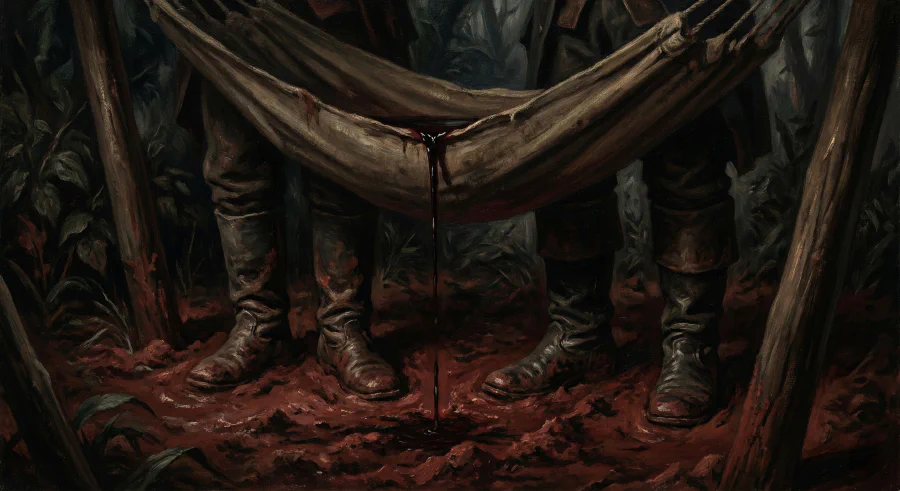
Before you begin reading “The Weight of the Hammock”, it is important to be aware of the nature of this narrative. This is a work of historical fiction with nuances of psychological and visceral horror, set in Colonial Brazil in 1726.
Originally written in Portuguese, the intent of this text is to confront the rawness and brutality of a period defined by invasions, territorial expansion, and bloody conflicts. To maintain historical accuracy and the story’s emotional impact, no details regarding the violence of the era have been spared.
Trigger Warnings
This work contains explicit and detailed descriptions that may be disturbing to some readers. The themes addressed include:
Extreme Graphic Violence: Lethal combat and realistic descriptions of injuries.
Physical and Psychological Torture: Passages detailing mutilation and the prolonged suffering of characters.
Colonial Atrocities: Depictions of massacres against indigenous populations.
Infanticide and Violence against Pregnant Women: Sensitive content involving the loss of innocent lives and gestational violence (specifically in chapters VIII and XI).
Psychological Terror: Hallucinations, guilt, and the weight of moral degradation.
Editorial Considerations
“The Weight of the Hammock” does not seek to glamorize the figures of the bandeirantes or the suffering of their victims. Instead, it explores the shadows of the human psyche and the irreversible consequences of betrayal and ambition.
We recommend this reading only for an adult audience with the emotional resilience to handle the themes mentioned above. If you are sensitive to any of these topics, we suggest you proceed with caution or stop reading if necessary.
Literature is a mirror, and sometimes, what it reflects is the darkest part of our history.
Have an insightful (and intense) read.
The Weight of the Hammock
By Lenon Cristhians da Silva
CHAPTER I: TERRIBLE THINGS
The hammock swayed between the poles like a cocoon of wounded flesh. Four men carried it—two in front, two behind—and their steps sank into the red mud surrounding the Village of Santana de Parnaíba. Inside, Captain Rodrigo de Almeida moaned. His were no ordinary moans, though the pain was there, constant, gnawing at what remained of his destroyed throat. They were shapeless sounds, gurgles of blood and saliva that dripped from the corners of his mouth. Gaspar Vaz walked beside the hammock, one hand firm on the wooden pole. People crowded the doorways of Mud-and-wattle huts, crossing themselves, murmuring prayers. Some asked what had happened. Gaspar replied in a tired but steady voice: the Indians attacked at dawn. Savages. They burned the camp, massacred men in their sleep. The Captain had survived by the grace of God.
The bell of the main church tolled three slow peals. Father Anselmo descended the stone steps, hands clasped over his brown habit. His aged face contracted at the sight of the Captain’s condition, and he made the sign of the cross. Behind the priest, the village clerk held a worn notebook, taking down names.
“How many men had departed on the expedition?”
“Seventeen.”
“How many return?”
Gaspar counted: nine. The clerk asked about the others.
“Dead,” Gaspar replied, his voice hoarse with exhaustion. “Poisoned arrows. War clubs. Some burned alive.”
The clerk lowered his eyes and scribbled more notes. Gaspar looked at the hammock. Captain Rodrigo moved his head, trying to fix his gaze on the priest, and a guttural sound escaped from his ruined throat—supplication or agony, impossible to say. Gaspar gripped the pole. They had walked for weeks to bring him back alive. Weeks carrying that weight.
Father Anselmo approached the hammock, and Gaspar saw the color drain from the Jesuit’s face. Captain Rodrigo de Almeida—who had departed two months earlier upright as a cedar, thunderous voice capable of making men tremble with a single order—was now a ruin of flesh and bone. His face was swollen, purple in some parts, yellowed in others, like rotten fruit forgotten in the sun. His beard had grown dirty, tangled with dried blood and something that might be pus. His lips were split, cracked until they bled, and when they opened they revealed broken teeth, some torn out by the root. But it was the throat that drew the eye—an irregular hole at the base of the neck, covered with bloodied rags that Gaspar changed twice a day. The skin around it was black, necrotic, smelling of spoiled meat even from a distance. The Captain’s hands were bound to his chest with leather strips, and when the priest looked more closely, he saw: the fingers were all broken, bent at impossible angles, some just stumps where the tips had been torn off. The nails that remained were black. The Captain wore tatters of what had been a leather doublet, now torn and impregnated with filth that wouldn’t come out. His legs, visible beneath the hammock, were thin as dry branches, swollen knees covered with open wounds. Father Anselmo stepped back, hand to his mouth.
“The savages tortured him,” Gaspar said, low. “We found him being tortured at the edge of the forest during the attack. We managed to pull him away from them, but…”
The priest swallowed hard and made the sign of the cross again, faster, almost desperate.
“During the attack?” he repeated, his voice failing.
Gaspar nodded.
“In the midst of the chaos, I heard screams coming from the forest. I found the Captain tied up, left to die. We managed to fight back, drive them off, but the damage was already done. The Captain…”
He paused, as if the words cost him effort.
“They did terrible things to him.”
He didn’t elaborate. He didn’t need to. The Captain’s body spoke for itself. Father Anselmo closed his eyes, murmured a prayer in Latin, the words stumbling over one another. When he opened his eyes again, he looked at Gaspar with something that could be compassion or terror.
“And you… managed to bring him back.”
Gaspar held his gaze.
“I couldn’t leave him there. He is the Captain.”
The clerk continued writing, the pen scratching the paper. Names of the dead. Circumstances. Approximate location. Gaspar recited everything with tired precision: João da Silva, killed by an arrow to the chest. Filipe Fernandes, war club to the head. Mateus Pires, burned alive when he tried to flee. The list dragged on, and with each name the clerk made a small cross beside it. When Gaspar finished, the man closed his notebook and looked at the hammock.
“And the Captain? Can he speak?”
Gaspar shook his head.
“They tore out his tongue. Crushed his throat. He breathes, eats when I feed him, but…”
He let the sentence die. The Captain let out another moan, louder this time, and tried to raise one of his bound hands. Gaspar placed his hand on the man’s shoulder, firm.
“Easy, Captain. We’re home now. You’re safe.”
An older man emerged from the crowd, wearing a worn leather doublet and a wide-brimmed hat. It was the village Captain-major, Lourenço Castelo Branco, a man with a graying beard and a suspicious gaze. He stopped before the hammock and studied Rodrigo de Almeida for a long moment. Then he looked at Gaspar.
“You led the counterattack?”
Gaspar hesitated only a second before answering.
“Yes, sir. When we found the captain’s body, we acted quickly. We killed as many as we could. The rest fled into the forest.”
Lourenço nodded slowly, his eyes still fixed on Gaspar.
“How many of them?”
“Twenty, maybe thirty. Hard to count in the midst of smoke and blood.”
Lourenço didn’t look away.
“And you assumed command after the Captain fell?”
“There was no other way, sir. Someone needed to lead.”
The Captain-major walked a few steps around the hammock, observing Rodrigo’s destroyed body. He stopped beside Gaspar and spoke low, almost a whisper.
“He was a good man. A good leader.”
Gaspar agreed in silence. Lourenço continued:
“You did what you could. Brought him back. That counts.”
He paused.
“But I’ll need a full report. Tomorrow, at the council house. Every detail.”
“I’ll be there,” Gaspar replied.
Lourenço gave Rodrigo one last look, then turned to the crowd.
“Take the Captain to his house. Prepare a room. Call a healer.”
He turned to Gaspar.
“You… rest. You look like you haven’t slept in days.”
Gaspar didn’t respond. He only watched as the men lifted the hammock again and began walking toward Rodrigo’s house, a stone and wattle construction at the end of the main street. The crowd followed them, curious, silent. Father Anselmo stayed behind, his eyes still fixed on Gaspar. There was something in the Jesuit’s gaze—not accusation, but doubt. An unasked question. Gaspar held the gaze for a moment, then turned and followed the hammock. The weight he had carried for weeks was still there, invisible but present. And he knew it wouldn’t leave anytime soon.
In the distance, behind the council house, a Aldeado, a settled Indian, watched everything in silence. His Christian name was Antonio, but few in the village remembered this. He stood like a shadow, dark eyes fixed on the hammock, then on Gaspar. He didn’t move when Gaspar passed him. He said nothing. He only watched, expression empty, like someone seeing a ghost walking among the living. When the procession disappeared inside Rodrigo’s house, Antonio turned and walked slowly back to the outskirts of the village, where the Aldeados lived in straw huts. Father Anselmo saw him leave and felt a chill run up his spine. There was something wrong in that look. Something he couldn’t name.
Inside the house, Gaspar helped place the Captain on a wooden bed covered with clean sheets that were already beginning to stain with blood and pus. The healer, an old, bent woman named Maria Gomes, examined the wounds with trembling hands. She shook her head.
“This man should be dead.”
She looked at Gaspar.
“How is he still breathing?”
Gaspar had no answer.
“The will of God,” he said, because it was what everyone expected to hear.
Maria snorted, skeptical, but didn’t argue. She began cleaning the wounds with boiled water and rags, murmuring prayers under her breath. The Captain moaned with each touch, his body writhing, but he had no strength to resist.
Gaspar stood beside the bed, watching. The afternoon light entered through the small window, illuminating Rodrigo’s destroyed face. For a moment, the Captain’s eyes opened—deep, feverish, but conscious. He looked directly at Gaspar. There was something in that gaze. Recognition. Perhaps accusation. Perhaps supplication. Gaspar didn’t look away. He held the gaze until the Captain’s eyes closed again, his body relaxing into something that could be sleep or unconsciousness. The healer finished her work and left, making the sign of the cross. Gaspar remained. He pulled up a chair and sat beside the bed. He would stay there all night if necessary. After all, it was what a good subordinate would do. It was what a hero would do.
Outside, the church bell tolled six peals. The sun was beginning to set, tinting the sky orange and red, colors of fire and blood. Gaspar looked out the window and thought of the backlands. Of the bonfires. Of the screams. He thought of many things he wouldn’t say tomorrow at the council house. Many things no one would ever know. He closed his eyes and, for an instant, seemed to hear a cry—weak, distant, like a child’s. He opened his eyes. Silence. Only the sound of the Captain’s irregular breathing and the wind beating against the clay tiles. Gaspar clenched his fists. He was home. He was safe. Now, he just needed to rest.
CHAPTER II: SHADOWS OF A GREAT MAN
Three months earlier
Captain Rodrigo de Almeida’s voice echoed through the square like distant thunder. Gaspar was kneeling on the packed earth floor, gathering the maps that had fallen from his pack when he’d stumbled on a stone. He felt the weight of gazes—from the other bandeirantes, from the merchants, from the women who had stopped washing clothes at the fountain to watch. He felt, above all, the Captain’s gaze.
“Get up, Gaspar,” Rodrigo said, and there was something in his tone that wasn’t exactly cruel, but neither was it kind. It was the voice of someone speaking to a child who needs to learn. “A man who can’t carry his own belongings shouldn’t carry greater responsibilities.”
Gaspar gathered the maps with trembling hands and stood up. His face burned. Rodrigo stood before him, taller, broader, more present. He wore a fine leather doublet, boots that came from Lisbon, a plumed hat that cost more than Gaspar earned in three months. He was forty-two years old, dark hair beginning to gray at the temples, beard carefully trimmed. He seemed carved from stone—immobile, imposing, untouchable.
“Sorry, Captain,” Gaspar murmured.
“Apologies don’t bring gold, Gaspar. Competence does.”
Rodrigo turned and walked toward the council house, and the men waiting for the meeting followed him like ob edient shadows. Gaspar stayed behind, the crumpled maps pressed to his chest, watching the Captain’s broad back disappear through the wooden door. Something burned inside him—not just shame, but something deeper, darker. Something that had no name, but that grew each day like a weed.
Gaspar Vaz was twenty-seven years old when he met Rodrigo de Almeida. He was the son of a Portuguese soldier without fortune and a mixed-race woman who had died in childbirth. He had grown up in the streets of Parnaíba, learning to survive with small jobs—porter, messenger, blacksmith’s assistant. At eighteen, he joined his first bandeira as a provisions carrier. He learned to walk in the wilderness, to read tracks, to negotiate with Indians. By twenty-four, he was already considered good enough to be promoted to squad leader. But never good enough to be more than that.
Rodrigo, on the other hand, had been born with a silver spoon. Son of a Captain-major of São Paulo, he had inherited land, slaves, connections. His first bandeira had been at twenty, led by his own father. When the old man died—devoured by fever in the backlands of the northern territories—Rodrigo had assumed the mantle without hesitation. He had a natural talent for command. A voice that made men obey without question. A presence that filled any room. He was everything Gaspar wasn’t and never would be.
And Gaspar hated him for it. Or loved him. Sometimes he didn’t know the difference.
The bandeira being prepared was ambitious. Seventeen men, three months of walking, objective of mapping commercial routes in the interior and establishing alliances with indigenous villages. Rodrigo would lead, as always. Gaspar would be second in command—a promotion that should have filled him with pride. But all he felt was the weight of Rodrigo’s shadow falling over him.
Gaspar knew that region. He had been there eight months earlier, on a smaller reconnaissance mission—just six men, two weeks of walking, basic mapping. It was on that expedition that he had learned the trails, the rivers, the places where water was abundant and where it was scarce. Knowledge that Rodrigo now wanted to use for his own glory.
The night before departure, there was a celebration at the Captain’s house. Gaspar was one of the last to arrive. The house was large, built of stone with imported tile roofing. Inside, wax candles illuminated an abundant table—pork, fresh bread, wine brought from the Kingdom. The men of the bandeira were gathered, laughing, drinking, telling stories of past expeditions. Rodrigo was at the center of everything, as always, glass in hand, easy smile on his lips.
Gaspar stayed in the corner, drinking slowly, watching. He always watched. The way the men leaned in when Rodrigo spoke. The way they laughed at his jokes even when they weren’t funny. The way they sought his approval with furtive glances, like dogs waiting for a bone.
“Gaspar!”
Rodrigo’s voice cut through the noise. Everyone turned. Gaspar raised his eyes.
“Come here, man. Don’t stand there in the corner like a ghost.”
Gaspar crossed the room. The men made way. Rodrigo placed a heavy hand on his shoulder.
“This one,” Rodrigo said, raising his voice so everyone could hear, “is my second in command. Gaspar Vaz. Good tracker. Knows the wilderness like few others. He’s been in that region before, on a smaller expedition.”
There were murmurs of approval. Gaspar felt the warmth of Rodrigo’s hand through the fabric of his shirt. He also felt its weight—not just physical, but symbolic. A hand that granted, but also controlled.
“However,” Rodrigo continued, and the room fell silent, “he still has much to learn about leadership. About command. About what it means to be responsible for lives beyond your own.”
The hand squeezed, almost imperceptibly.
“So I’m going to teach him. On this expedition, he’ll learn what it is to be a Captain.”
He smiled, and it was a genuine smile, almost paternal.
“If he survives, of course.”
Laughter. The entire room erupted in guffaws. Gaspar forced a smile. Rodrigo’s hand released his shoulder and he returned to the corner, his face burning again. He grabbed another glass of wine and drank it all at once. The liquid went down bitter.
They departed at dawn. Seventeen men, ten mules loaded with provisions, weapons, tools. Rodrigo rode in front, mounted on a sorrel horse that gleamed in the sun. Gaspar walked behind, on foot like the others. The hierarchy was clear even in the arrangement of the march.
The first days were quiet. They followed known trails, crossed shallow rivers, camped in safe clearings. Rodrigo distributed orders with natural efficiency. Where to go, when to stop, who would stand guard. Gaspar executed everything without question. He was good at this—obeying. He always had been.
But at night, when they lit bonfires and the men relaxed, Gaspar watched. Rodrigo always sat on a higher log, separated from the others by a subtle but deliberate distance. He told stories of past expeditions. Of the gold he had found. Of the Indians he had subdued. Of the lands he had mapped. And the men listened, hypnotized.
Gaspar listened too. And something inside him twisted.
In the second week, they reached territory Gaspar knew. The trails were familiar now, the landmarks he had memorized months before still intact. He guided the bandeira with precision, avoiding swampy areas, finding the best places to camp. Rodrigo didn’t thank him. He just nodded, as if it were expected, as if it were an obligation.
And perhaps it was. But something in Gaspar desired more. Desired recognition. Desired that Rodrigo look at him not as a useful subordinate, but as an equal. As a capable man.
It didn’t happen.
“You’re distracted, Gaspar.”
Rodrigo’s voice pulled him from his thoughts. They were camped in a clearing, the sun had already set, and Gaspar was sitting before the bonfire, staring at the flames without really seeing them. Rodrigo stood beside him, arms crossed, expression serious.
“Sorry, Captain,” Gaspar said, automatically.
“Apologies again.”
Rodrigo sat down beside him, picked up a stick and poked the embers.
“You need to learn to maintain focus. Leadership demands constant attention. A moment of distraction can cost lives.”
Gaspar didn’t respond. Rodrigo continued poking the fire.
“I know it’s not easy being under another man’s command. Especially when you know the terrain better than I do.”
Gaspar raised his eyes, surprised.
“But knowing trails isn’t the same as leading men,” Rodrigo continued. “There’s a difference between knowing the way and having the authority to make others follow. Do you understand that?”
“Yes, sir.”
“I hope so.”
Rodrigo stood up, tossed the stick into the fire.
“Rest. Tomorrow we continue early.”
And he left, leaving Gaspar alone with the flames and with the anger that grew, slow and inevitable, like fire in dry straw.
That night, Gaspar dreamed he was the one on horseback, he was commanding, he was receiving the men’s reverence. He dreamed that Rodrigo walked behind, on foot, carrying crumpled maps.
But when he woke, he was in the same clearing, surrounded by the same men, under the command of the same Captain. And the shadow remained there, heavy and inescapable, covering everything.
CHAPTER III: FLESH AND EARTH
Eight months earlier
The reconnaissance expedition was small. Six men, three mules, two weeks planned in the backlands. The objective was simple: map potential commercial routes, identify indigenous villages for future alliances, return with information that could be sold to the captains planning larger bandeiras.
Gaspar Vaz had been chosen as lead guide—his first time leading men, even if few. It was an opportunity to prove his worth. To show he was more than a porter, more than an eternal subordinate.
The other five were a mixture: two older Portuguese who needed quick money, two mixed-race men experienced in trails, and Antonio—a Aldeado who would serve as interpreter and intermediary with interior tribes. Antonio was a man of few words, a silent observer who moved through the forest like a shadow.
They departed from Parnaíba on a cloudy morning, heading west, where maps became vague and stories abounded about gold, precious stones, and hostile savages.
It took ten days to reach the village.
It lay in a wide clearing surrounded by dense forest, on the banks of a dark-water river. Palm-thatched huts arranged in a semicircle, smoldering bonfires, children running between the spaces. It wasn’t a large village—perhaps forty people, mostly women and children, some young warriors, elders bent by time.
Antonio approached first, hands raised in a gesture of peace, speaking in Tupi. An old man emerged from one of the larger huts—the chief, Gaspar presumed. His body marked by ritual scars, his gaze suspicious but not hostile.
There was a long conversation. Antonio gestured, pointed to the Portuguese, to the mules, to the knives and fishhooks they brought as gifts. The chief listened, then responded. Finally, he nodded.
Antonio returned.
“We can stay three days,” he said in broken Portuguese. “Trade. Rest. Then we continue.”
Gaspar agreed. Three days were enough to map the region, establish relations, depart.
That’s when he saw her.
A young woman who seemed to have just left childhood behind, but whose shoulders still lacked a woman’s breadth, was crouched near a bonfire, grinding corn on a stone. She wasn’t beautiful in the way the Portuguese understood—dark skin, straight black hair falling over bare shoulders, bare feet dirty with earth. But something about her caught Gaspar’s eye. Perhaps the way she moved, silent and efficient. Perhaps the curve of her back, the concentration on her face. Perhaps just the loneliness he carried and that sought to fill itself with anything.
She noticed she was being watched and raised her eyes. Gaspar didn’t look away. Neither did she. For a moment, there was something—recognition, curiosity, perhaps just chance. Then she returned to her work.
Gaspar felt something strange in his chest. Something he hadn’t felt in a long time.
The three days extended to six. The chief was satisfied with the trade—iron knives for information about routes, fishhooks for permission to map the region. Gaspar was in no hurry to leave. Here, far from Parnaíba, far from men who saw him as an eternal subordinate, he was the one who commanded. He was the one who made decisions.
And there was her, Iara.
He always returned to the place where he’d first seen her. He discovered she was the chief’s daughter—not yet anyone’s wife, responsible for helping prepare food for the tribe. She didn’t speak Portuguese. He didn’t speak Tupi. But they found ways to communicate. Gestures. Glances. Shy smiles when no one else was paying attention.
On the fifth night, she appeared near where Gaspar had mounted guard at the edge of the camp. She simply emerged from the darkness, silent as all things of the forest. She stood a few steps away, watching him.
Gaspar stood up.
She didn’t flee.
They approached each other. There were no words. Iara touched his face with rough fingers, calloused from work. Gaspar held her hand, feeling the warmth of her skin against his.
And then she pulled him. Into the forest. Away from the bonfires. To a place where no one would see them.
They lay on the damp earth among twisted roots. The foliage crackled beneath their bodies. Gaspar felt small stones pressing into his back, the dampness of the ground soaking his clothes. He didn’t care.
His hands found her bare skin, rough in some places, soft in others. Iara didn’t hesitate. She pulled him down. There was no shyness in her, no Christian hesitation. Just direct desire, natural, honest.
She guided him with a confidence that surprised him. Gaspar tried to take control, but Iara was strong, more than her visible adolescence suggested. She turned him, mounted him, and for a moment he almost protested—this wasn’t how it should be, he should command, he was a man, Portuguese—but then she moved and thoughts died.
The sky above spun through the leaves. Light and shadow. Gaspar gripped her hips, trying to maintain some control, some illusion of power. But it was she who dictated the rhythm, she who decided when and how. And Gaspar hated it. And loved it. Hated that she made him feel weak. Loved that she wanted him.
When it ended, it was quick, almost brutal. Gaspar panted, his body tense. Iara leaned over him, kissed his forehead, murmured something in Tupi that sounded like tenderness. He didn’t reciprocate. He just lay there, looking at her face above his, drops of sweat running from her forehead to his.
She smiled. Genuine. Happy.
And Gaspar felt something twist inside him. Not gratitude. Not affection. But possession. She was his now. His to use. His to… what? He didn’t know. But in that moment, for the first time in years, he possessed something no one else could claim.
Iara rolled to the side, lay beside him on the earth, still touching his arm. Gaspar let her. For now.
They lay side by side, looking at the canopy of trees above. Iara spoke in Tupi, soft words Gaspar didn’t understand. He pretended to listen, but his mind was elsewhere. He thought of Parnaíba. Of how no one there would know about this. Of how this was his, only his. Secret. Powerful.
And he thought of Iara, lying beside him, naked and vulnerable, and felt something strange. It wasn’t love—he didn’t know if he was capable of love. But it also wasn’t complete contempt. It was something between the two. Desire mixed with… what? Unease. As if part of him knew this was wrong, but couldn’t name why.
She was an Indian. Inferior. Savage. A child.
But she wanted him. And that made him feel superior.
For now, it was enough.
They returned to the village separately. Gaspar first, Iara ten minutes later. No one seemed to notice. Or if they noticed, they didn’t care. Relations between bandeirantes and Indian women were common—necessary, even, to keep the peace. As long as they remained discreet.
In the following days, Gaspar and Iara met whenever they could. Always in the same hidden clearing. Always in silence, or nearly so. She spoke in Tupi, words he didn’t understand but that seemed important. He responded in Portuguese, knowing she didn’t comprehend, but needing to say something.
“You’re different from the others,” he said once, lying beside her, watching an ant climb up her arm. “You don’t judge me. You don’t diminish me.”
Iara turned her head, looked at him with those dark, direct eyes. She said something in her language, tone soft, almost intimate. Gaspar didn’t understand the words, but the tone made him feel… something. Discomfort, perhaps. As if she were offering more than he could give. As if she saw things in him that didn’t exist.
He looked away.
“You’re beautiful,” he said, because it was easier to talk about the body than anything else. “For an Indian.”
He touched her again, and she responded, but there was something different now. An urgency in her that wasn’t there before. A need. Gaspar felt it and something inside him recoiled. She was beginning to want more. And he had no more to give.
Two weeks passed. The expedition should have departed days ago, but Gaspar kept delaying. He invented excuses—they needed to map more areas, establish better relations, guarantee safe routes. The other men began to grow impatient, but they obeyed. He was the one leading the reconnaissance of the region.
Antonio, however, watched. Always watched. Gaspar noticed the Aldeado’s glances—he knew, probably. Knew about Iara. Knew about the nightly meetings. But he said nothing. He only watched with those black, impenetrable eyes.
Finally, there was no way to delay further. Provisions were running out. The men demanded to return. Gaspar agreed.
On the last night, he met Iara one last time. She waited for him in the usual place, and when she saw him, she smiled. But there was sadness in the smile. As if she knew.
They lay together once more. Afterward, she held his hand, placed it over her own chest, over the heart that beat fast. She said something in Tupi—long, urgent, important.
Gaspar didn’t understand. Didn’t want to understand. He just nodded, as if he comprehended.
When he dressed to leave, she remained there, naked on the earth, watching. She didn’t try to hold him. She didn’t cry. She only watched with those eyes that seemed to see through him.
Gaspar turned and left. He didn’t look back.
The expedition departed at dawn. Gaspar led the men back to Parnaíba, following the trails he had mapped, the rivers he knew. Antonio walked in silence, as always. The others talked about the mission’s success, about the gold they would receive for the maps, about the next expeditions.
Gaspar didn’t participate in the conversations. He just walked, looking ahead, trying not to think about Iara left behind. Trying not to think about what she had said on the last night, words he hadn’t understood but that sounded like promise or plea or both.
Trying not to think that, for the first time in his life, someone had seen him as more than a subordinate, more than a shadow, more than a tool.
And he had abandoned her anyway.
Because deep down, Gaspar knew: as long as he was trapped in Parnaíba, as long as he lived under the shadow of men like Rodrigo, nothing would truly be his. Not land, not glory, not love. Nothing.
Better not to have, he thought, than to have and lose.
Better never to return.
They reached Parnaíba three weeks later. Gaspar delivered the maps, received payment, was praised for his efficiency. The expedition had been a success.
And Iara, in the distant village, was left behind. Forgotten. Or so Gaspar tried to believe.
But at night, when he lay alone on his mat, he closed his eyes and still saw her. That sad smile. Those incomprehensible words. That hand over her heart.
And something inside him—small, buried, ignored—whispered that he had made a mistake.
That he had left behind the only thing that had ever truly been his.
But it was too late. And Gaspar, as always, pushed the thought away and moved forward.
There were other expeditions to come. Other opportunities to prove his worth. Other shadows under which to live.
Iara was just one more thing left in the past. Buried. Forgotten.
Or so he tried to believe.
CHAPTER IV: GROTESQUE DEVOTION
Present
The second day in Parnaíba dawned cloudy. Gaspar woke in the chair beside the Captain’s bed, his body aching, his neck twisted from bad position. He had slept only two hours, maybe three. Bad dreams. Fire. Screams. A woman lying still, looking at him without accusation, just infinite sadness.
He rubbed his eyes and looked at Rodrigo. The Captain was awake—or something close to it. His half-closed, glassy eyes followed the movement of a fly buzzing near the ceiling. His breathing was irregular, a rough, wet sound that reminded one of a punctured bellows. The smell of necrotic flesh had worsened overnight. Even with the window open, the air in the room was thick, almost solid.
Gaspar stood up, his knees cracking. He walked to the table where Maria Gomes had left basins of clean water, rags, and a bowl of corn porridge. He grabbed one of the rags, wet it in the water, wrung it out. He approached the bed.
“Good morning, Captain,” he said, his voice hoarse from sleep. “Let’s clean you up.”
Rodrigo didn’t respond. He couldn’t. But his eyes moved slightly in Gaspar’s direction. There was something in that gaze—terror? Supplication? Hatred? Gaspar was never sure. He preferred not to think too much about it.
He started with the forehead, cleaning the dried sweat and accumulated dirt. The cloth turned brown immediately. Gaspar rinsed, wrung it again, continued. He passed over the eyes, the nose, the tangled beard. Rodrigo remained motionless, only his eyes following each movement with feverish intensity.
When Gaspar reached the mouth, Rodrigo moaned. A low, guttural sound that could mean anything. Gaspar hesitated only a second, then passed the cloth over the cracked lips, removing dried blood and thick saliva. His fingers grazed the stumps of broken teeth. Rodrigo tried to turn his head, but had no strength. He lay there, receiving the care like a child receives a bath—passive, humiliated, dependent.
“Easy, please,” Gaspar said, softly. “It’ll be over soon.”
He moved to the neck. To the hole where there had once been a whole throat. He removed the bloodied rags covering the wound, and the smell that freed itself was so strong that Gaspar had to turn his face. He breathed through his mouth, counted to three, returned to work.
The flesh around the wound was black in some spots, greenish-yellow in others. Pus flowed slow and thick. Gaspar cleaned carefully, trying not to press too hard, but with each touch Rodrigo contracted, louder moans escaping from the hole in his throat. Wet, horrible sounds that shouldn’t come from a human being.
“I know it hurts,” Gaspar said, continuing. “But it needs to be done. Otherwise it’ll get more infected. Otherwise you’ll die.”
Rodrigo stared at him. And for the first time, Gaspar was certain of what he saw in those eyes: accusation. Pure, clear, unmistakable. You did this to me.
Gaspar held the gaze.
“I saved you,” he said, low. “Remember? I brought you back. You’d be dead if it weren’t for me.”
Rodrigo’s eyes didn’t change. They just kept staring, implacable.
Gaspar finished cleaning the wound and applied a paste Maria Gomes had prepared—herbs, honey, something that smelled rotten but supposedly helped. Rodrigo writhed, tried to scream, but only those wetsounds came out. Gaspar held him firm by the shoulders.
“Easy, I said.”
He placed clean rags over the wound, tied them with cloth strips around the neck. Rodrigo trembled now, his whole body shaking. Fever or terror, impossible to distinguish.
Gaspar moved to the hands. He untied the leather strips that kept the broken fingers immobile against the chest. When he freed the hands, they fell open on the sheets like dead spiders. The fingers were all crooked, some bent at angles that defied anatomy. The tips of three of them were just black stumps where nails and phalanges had been torn out.
Gaspar took one of the hands and began to clean it. Rodrigo moaned louder, tried to pull his hand back, but Gaspar held firm.
“No,” he said, paternal tone. “Let me take care of you.”
He cleaned between the fingers, where blood and dirt had accumulated. He removed scabs. He applied the herbal paste. Rodrigo was crying now—silent tears that ran down the corners of his eyes, wetting the pillow. Gaspar saw but didn’t comment. He just continued working, methodical, almost affectionate.
When he finished, he tied the hands back to the chest. Rodrigo lay there, exhausted, trembling, eyes fixed on the ceiling.
“There,” Gaspar said. “Now let’s eat.”
He grabbed the bowl of porridge and sat on the edge of the bed. Rodrigo slightly turned his head, looked at the bowl, then at Gaspar. There was something in his eyes now—supplication. Hunger, perhaps. Or fear of what was coming.
Gaspar took a spoonful of porridge.
“Open your mouth.”
Rodrigo didn’t move. Gaspar waited. Five seconds. Ten. Then he sighed.
“Captain, you need to eat. Otherwise you’ll die of weakness. Is that what you want?”
No response. Just that fixed, accusatory gaze.
Gaspar set the bowl aside and leaned closer.
“I know what you’re thinking,” he said, voice low, almost intimate. “You think I did this to you. You think I betrayed you.”
Pause.
“But you were there, Captain. You saw the savages. You saw what they did. I just… I just did what had to be done. I led. Like you always wanted me to.”
Rodrigo blinked. New tears rolled down.
Gaspar grabbed the bowl again.
“Now open your mouth. Please.”
Rodrigo finally obeyed. He opened his mouth—or what remained of it—and Gaspar placed the spoon inside. The porridge ran down the corners of his lips, down his chin. Rodrigo tried to swallow and choked, his body contracting. Gaspar waited, patient. When the coughing passed, he tried again.
It took twenty minutes to feed him. Half the porridge ended up on the sheets, but enough went in. When he finished, Gaspar cleaned Rodrigo’s face with almost tender delicacy.
“Good,” he said. “Very good. You’re getting better.”
Rodrigo stared at him. He wasn’t getting better. They both knew it.
Gaspar stood up, took the bowl back to the table. When he turned, he saw Antonio standing in the doorway.
The Aldeado was motionless, watching the scene. He said nothing. He only looked—at Gaspar, at Rodrigo, back at Gaspar. There was something in that gaze that Gaspar didn’t like. Something that seemed like judgment.
“What do you want?” Gaspar asked, sharper than he intended.
Antonio didn’t respond immediately. He took a step into the room, looked at Rodrigo. The Captain tried to turn his head in the Indian’s direction, made an urgent, desperate sound. Antonio approached the bed.
“No,” Gaspar said, blocking the way. “He needs rest.”
Antonio stared at him. Small, thin, but there was steel in those dark eyes.
“I was there,” Antonio said, in broken but clear Portuguese. “On the first expedition. Eight months ago. I saw.”
Gaspar felt his blood run cold.
“Saw what?”
“I saw you with her. The chief’s daughter. Iara.”
The name left Antonio’s mouth like an accusation. Gaspar clenched his fists.
“I don’t know what you’re talking about.”
“Yes you do,” Antonio said, eyes fixed. “You were with her every night. I thought you would stay. I thought you would take responsibility. But you left. You left her.”
Pause. Antonio looked at Rodrigo, then back at Gaspar.
“She got pregnant. With your child.”
The silence that followed was heavy as lead. Gaspar felt his heart pounding in his ears. Rodrigo moaned low, trying to speak, trying to say something impossible without tongue, without voice.
“You don’t know anything,” Gaspar said, voice controlled but dangerous. “You weren’t there when the Indians attacked. You didn’t see what they did.”
“I didn’t see the attack,” Antonio agreed. “But I saw afterward. I saw that her body wasn’t with the others. I saw you return from the forest alone, hours after the massacre. I saw the fresh blood on your clothes that wasn’t from fighting.”
Gaspar took a step forward, threatening.
“Be careful with accusations without proof, Indian. That can be costly.”
Antonio didn’t step back. He held the gaze, firm.
“I have no proof. But I know. And he knows.”
He pointed at Rodrigo.
“He saw everything. And he can’t tell.”
Gaspar clenched his fists until his nails dug into his palms.
“Get out,” he said, low. “Now.”
Antonio looked at him for one more long moment. There was something in that gaze—not just accusation, but sadness. Deep sadness for something lost that could never return.
“She loved you,” Antonio said, finally. “Truly. She spoke of you like you were the sun. She thought you would come back to her.”
He turned to leave.
“And you ended everything like it was nothing.”
He left, silent as he had come.
Gaspar stood there, trembling, his fists still clenched. He turned to Rodrigo. The Captain stared at him with wide, feverish, accusatory eyes.
“He doesn’t know anything,” Gaspar said, but his voice lacked conviction. “Nobody knows. Only you and me. And you can’t tell, can you?”
Rodrigo moaned. A long, high-pitched, desperate sound.
Gaspar approached the bed, leaned over the Captain.
“Nobody’s going to know,” he whispered. “I guarantee it. I’ll take care of you. Always. Like I always have.”
He placed his hand on Rodrigo’s forehead, in a gesture that could be affection or threat. Rodrigo closed his eyes, new tears escaping.
Later, when the sun was already high, Father Anselmo arrived. He brought a wooden crucifix and a worn Bible. He stopped at the room’s door, looked at the scene—Gaspar sitting beside the bed, Rodrigo lying motionless—and made the sign of the cross.
“How is he?” the priest asked.
“Stable,” Gaspar replied. “Weaker, but stable.”
Father Anselmo entered slowly, approached the bed. He looked at Rodrigo and the compassion on his face was genuine.
“Poor creature of God,” he murmured. “Such suffering.”
He placed his hand on Rodrigo’s forehead, murmured a blessing in Latin. Rodrigo opened his eyes, looked at the priest with something that could be hope. He made that urgent sound again, trying to communicate something.
Father Anselmo looked at Gaspar.
“He’s trying to say something.”
“He’s always trying,” Gaspar said. “But without a tongue… it’s impossible to understand.”
The priest studied Gaspar for a moment. There was doubt in that gaze, Gaspar noticed. Distrust. But the man said nothing. He only turned his attention back to Rodrigo.
“I will pray for you, my son,” he said, taking the crucifix. “I will ask God to ease your suffering.”
He began to pray in Latin, quick and familiar words. Gaspar sat, watching. Rodrigo kept his eyes fixed on the priest, as if those prayers were a lifeline in a stormy sea.
When he finished, Father Anselmo turned to Gaspar.
“Can he receive visitors?”
“I don’t think it’s advisable,” Gaspar replied quickly. “He’s too weak. Too traumatized. He needs peace.”
“I understand.”
The priest hesitated, then:
“And you, Gaspar? How are you dealing with all this?”
“I’m fine, Father.”
“Carrying so much weight… it’s not easy. If you need to confess, talk about what happened…”
“I don’t need to,” Gaspar interrupted. “I just fulfilled my duty. Like any man would.”
Father Anselmo studied him again. That penetrating gaze Gaspar hated.
“Of course,” the priest said, finally. “Any man.”
He stood up, took the Bible.
“I’ll return tomorrow. To continue the prayers.”
“Thank you, Father.”
When the Jesuit left, Gaspar let out a long sigh. He looked at Rodrigo. The Captain was crying again, silently, eyes fixed on the ceiling.
“He doesn’t know anything,” Gaspar said, more to himself than to Rodrigo. “Nobody knows. And nobody’s going to know.”
But deep down, he was beginning to have doubts.
Antonio knew.
Father Anselmo suspected.
And Rodrigo… Rodrigo was a living, silent witness, but living.
How long could he maintain the lie? How long would the truth stay buried?
Gaspar looked out the window. The sky was darkening. Heavy clouds approached from the east. Storm coming.
He closed his eyes and, once again, heard it. Weak, distant, impossible.
A child’s cry.
He opened his eyes. Silence.
Always silence.
Except for Rodrigo’s moans, which never stopped.
CHAPTER V: THE ROTTEN FRUIT
Five weeks earlier
Gaspar woke with the sun already high, his mouth dry as cured leather and his head throbbing in regular, painful pulses. He tried to open his eyes but the light was a blade that cut straight to his brain. He moaned, turned in the hammock, and the movement made his stomach turn. He leaned to the side and vomited—bitter liquid, almost pure alcohol, that ran down the edge of the hammock and dripped onto the earth floor.
He remained there for a long moment, breathing deeply, trying to remember where he was. The village. Rodrigo’s bandeira. Three weeks of walking. And now… here. Back.
Back to the place he’d sworn never to see again.
He heard voices from outside. Portuguese talking, the distant sound of Indians working. The village’s normal life continuing. Gaspar forced himself out of the hammock. His legs trembled. His head spun. He stumbled to where they kept the water, grabbed a gourd and drank it all at once. It didn’t help. The thirst remained, deep, unquenchable.
He dressed slowly, each movement an agony. When he finally emerged from the hut they shared as an improvised dormitory, the daylight hit him like a punch. He blinked, shielded his eyes with his hand, tried to orient himself.
The village was strangely silent. Gaspar immediately noticed—the Indians were all gathered near the center, forming a semicircle around something. Or someone. Low voices, tense. And then he heard Rodrigo’s voice, clear and authoritative, cutting through the murmur.
Gaspar’s stomach tightened.
He approached slowly, from behind the gathered Indians. He managed to see through the people: Rodrigo stood in the center, arms crossed, severe expression. Before him stood the chief—an old man with a body marked by ritual scars, hard gaze.
And beside the chief, head down, was her.
Iara.
Gaspar stopped where he was. The blood seemed to freeze in his veins.
She was different. Eight months had passed since he’d last seen her, and time had shown its work. She still had that black hair falling over her shoulders, that dark skin, those bare feet. But there was something new. Something that made Gaspar’s world tremble.
The belly.
Round. Obvious. Impossible to ignore. Six months, maybe seven. Iara was pregnant.
And by God, Gaspar knew whose it was.
The chief spoke in Tupi, voice loud, gesticulating. Rodrigo listened, impassive. Antonio stood beside the Captain, serving as interpreter, but his face was carefully neutral.
“The chief says,” Antonio translated, hesitant, “that his daughter is pregnant. That the father is a man from your bandeira. From a previous expedition.”
There were murmurs of approval. Rodrigo didn’t change expression.
“And he’s certain of this?”
Antonio translated. The chief responded, pointing at Iara, then gesticulating anger. The Indian woman kept her eyes down, one protective hand over her belly.
“She confessed,” Antonio said. “She said she was with one of the men who were here before. Months ago. He…”
Antonio paused, eyes meeting Gaspar’s for a second before looking away.
“He promised to return. She was waiting for him to come back to her.”
Gaspar felt the ground disappear beneath his feet. He wanted to retreat, disappear, turn to smoke. But he was frozen there, watching.
Rodrigo turned slightly, looked at the bandeira’s men who had also gathered to watch. Gaspar wasn’t among them—he was in the back, hidden among the Indians. But he felt the weight of that gaze even from afar.
“Tell the chief,” Rodrigo spoke, turning back to Antonio, “that I will investigate the matter. If any of my men dishonored his daughter, there will be consequences.”
Antonio translated. The chief didn’t seem satisfied. He responded with something quick, aggressive.
“He says that… that he doesn’t want an investigation,” Antonio hesitated again. “He wants justice now. He wants the man to marry her. Or pay. Or…”
“Or?” Rodrigo pressed.
“Or they will consider this an offense. A breach of alliance.”
The silence that followed was tense, dangerous. Gaspar saw the village warriors moving, hands near their spears. He saw his own bandeira companions positioning themselves, uncomfortable, hands near their weapons.
Rodrigo remained calm.
“Tell the chief he will have his answer by tomorrow. I will give the culprit the chance to come forward. If he doesn’t, I will discover him myself.”
Antonio translated. The chief grumbled something, spat on the ground, and turned away. Iara was pushed to follow him. Before disappearing between the huts, she glanced back.
Her eyes swept over the crowd. Searching. Hoping.
And they found Gaspar’s.
For a second—just one—there was recognition. Then hope. She took half a step in his direction.
Gaspar looked away and retreated into the shadows.
When he looked again, she had already disappeared. But the image remained engraved: that round belly, that protective hand, that hope in her eyes.
Rodrigo dismissed the gathering with a gesture. The Indians dispersed, murmuring among themselves. The bandeirantes did the same, talking low, speculating. Gaspar tried to move away, return to the hut, disappear. But Rodrigo’s voice froze him in place.
“Gaspar. Come here.”
It wasn’t a request. It was an order.
Gaspar turned slowly. The other men looked at him, curious, then continued on their way. In seconds, only Rodrigo and Gaspar remained in the village center. The Captain said nothing for a long moment. He only looked, and Gaspar felt that gaze descending to his bones.
“It was you,” Rodrigo said, finally. It wasn’t a question.
Gaspar opened his mouth. Closed it. He didn’t know what to say. To deny would be useless. To confirm would be suicide.
“Captain, I…”
“Don’t lie to me,” Rodrigo cut in, voice low but dangerous. “Antonio told me. He was on the reconnaissance expedition. He saw you with her. I thought it was just… momentary weakness. All men have it. But this…”
He took a step forward.
“You got her pregnant. And ran away.”
Gaspar lowered his eyes.
“It was… it was unintentional. I didn’t plan…”
“Unintentional?” Rodrigo gave a dry laugh, without humor. “You fucked an Indian woman unintentionally? How many times, Gaspar? How many times did you ‘unintentionally’ lie with her?”
Gaspar shrank from the crudeness of the words.
“I… don’t know. A few times. But I didn’t know she would…”
“Would get pregnant?” Rodrigo shook his head, incredulous. “Are you stupid or just pretending to be?”
Silence. Gaspar kept his eyes on the ground, his face burning.
“Look at me,” Rodrigo ordered.
Gaspar slowly raised his eyes. Rodrigo stared at him with a mixture of contempt and… disappointment. It was the disappointment that hurt most.
“I chose you as my second,” Rodrigo said, each word heavy. “I gave you responsibility. I trusted you. And you… you debase yourself with a savage. You stain this bandeira’s name, put all of us at risk, because of an Indian woman.”
“She’s not just a…”
“Shut up,” Rodrigo cut in, voice rising. “Don’t you dare defend her. What is she, Gaspar? A creature. A savage. And you… you lay with her as if she were your equal.”
The words were physical blows. Gaspar felt each one sinking in.
“Do you have any idea,” Rodrigo continued, “of the position you’ve put me in? The chief is furious. The alliance is at risk. And why? Because you couldn’t keep your pants on.”
“I’ll… I’ll fix this,” Gaspar said, desperate. “I’ll talk to the chief, I’ll…”
“You won’t do anything,” Rodrigo interrupted. “Absolutely nothing. You’ve done enough damage already.”
He turned his back, began to walk away. Gaspar felt panic.
“Captain, please. What… what’s going to happen to me?”
Rodrigo stopped, turned slightly.
“What should happen is you being expelled from the bandeira. Sent back to Parnaíba in disgrace. But I can’t do that now. Not here, not with the alliance at risk.”
Pause.
“So you’re going to keep quiet. You’re going to keep your head down. And when we return—if we return—you’ll never work under my command again. You’ll never be anything more than what you’ve always been: a nobody.”
He fully turned now, eyes cold as stone.
“And as for the bastard you created? You’re going to live with it. You’ll know that somewhere in the forest there’s a mixed-race child with your dirty blood running in its veins. Permanent proof of your weakness.”
Rodrigo spat on the ground, near Gaspar’s feet.
“You shame me.”
And he left.
Gaspar stood there for an indeterminate time. It could have been minutes. Could have been hours. The sun burned his neck. The shame burned more.
You shame me.
The words echoed, repeated, implacable.
A creature. A savage.
The bastard you created.
A nobody.
Gaspar felt something break inside him. It wasn’t sudden—it was slow, like a green branch that resists, resists, until it finally yields and cracks in two. And when it cracked, what remained wasn’t sadness. It wasn’t remorse.
It was anger.
Anger at Rodrigo, for his superiority, for his contempt, for everything he was and Gaspar never would be.
Anger at Iara, for getting pregnant, for waiting, for exposing him.
Anger at himself, for being weak, for wanting what he shouldn’t, for always failing.
But above all, anger at the situation. At the fact that all this existed—the pregnancy, the child, the shame—and would continue to exist. Rodrigo was right. It would be a permanent mark. Proof of his inferiority. An eternal reminder that he would never be good enough.
Unless…
The thought came silent, poisonous.
Unless it didn’t exist anymore.
Gaspar blinked, immediately pushed the thought away. No. This was madness. He couldn’t… he wasn’t capable of…
But the thought returned. Insistent.
If there was no pregnancy, there would be no shame. If there was no Indian woman, there would be no witness. If there was no problem…
Gaspar shook his head, trying to clear his mind. But it was too late. The seed was planted. And in soil as fertile as hatred and desperation, seeds grow fast.
He spent the rest of the day avoiding everyone. He sat alone at the village’s edge, looking at the dark forest beyond. He thought about fleeing. Simply disappearing into the wilderness, never returning. But where would he go? Without resources, without allies, without purpose? He’d be killed by hostile Indians or beasts within days.
No. Fleeing wasn’t a solution.
He thought about confronting Iara. Demanding she lie, say the father was someone else, release him from responsibility. But she would never do that. She loved him, stupidly and sincerely. She thought he would stay with her.
He thought about humbling himself before Rodrigo. Begging forgiveness, promising anything. But he already knew the answer. Rodrigo would never see him the same way. Trust was broken. Contempt, permanent.
All options led to the same conclusion: his life, as he knew it, was over.
Unless he changed the variables.
When the sun began to set, Gaspar finally stood up. His legs were numb from sitting so long. He walked back toward the village, each step heavy, deliberate.
He found João sharpening a knife near the bonfire.
“João,” Gaspar said, voice low. “Can I talk to you?”
João looked up, surprised.
“Sure. What is it?”
Gaspar sat beside him. For a long moment, he said nothing. He just watched the flames. Then, slowly, he began to speak.
“Do you think,” he said, choosing his words carefully, “the Indians are trustworthy? That they’re really our allies?”
João frowned.
“The chief seems honest. Why?”
“I don’t know,” Gaspar lied. “Just… I have a bad feeling. Like something’s going to happen.”
João studied him.
“You’ve been strange since this morning. Does it have something to do with that story about the pregnant Indian woman?”
Gaspar didn’t respond. He didn’t need to. João sighed.
“Look, whoever did it was stupid. But the Captain will handle it. He always does.”
“Yes,” Gaspar said. “He always does.”
But inside, another voice spoke. Clearer now. More decided.
Not this time. This time, I handle it.
That night, Gaspar lay in the hammock but didn’t sleep. He looked at the palm-thatched ceiling of the hut, tracing shadows with his eyes. He heard the other men’s breathing around him, deep, regular, innocent. They didn’t know what he was planning.
Gaspar closed his eyes. Not for the first time, he wondered if he was going insane. But the answer didn’t matter anymore.
What mattered was survival. It was keeping what remained of his dignity. It was proving—to Rodrigo, to everyone, to himself—that he was more than a nobody.
Even if he had to destroy everything to do it.
He turned in the hammock, the cords creaking under his weight. Outside, the village slept, peaceful, not knowing it was walking toward the abyss.
And Gaspar, for the first time in days, smiled in the dark.
A smile without joy. Without humanity.
Just decision.
CHAPTER VI: THE TORN TONGUE
Five weeks earlier—The following night
Gaspar waited until the moon was high. He waited until the village sounds changed—conversations dying, bonfires reducing to embers, children finally silencing. But that night, complete silence didn’t come. The village was celebrating.
High bonfires burned in the clearing’s center, larger than usual. Around them, Indians danced, sang, drank cauim from large clay jars. The celebration was for the sealed alliance—for the peace agreement between the chief and Captain Rodrigo. A commemoration that should bring prosperity, trade, mutual protection.
The chief was there, in the celebration’s center, smiling for the first time since his daughter’s matter had been raised. Rodrigo had promised to solve the problem. Had promised justice. And the old man had chosen to believe, chosen to celebrate, chosen to trust.
Fatal mistake.
Rodrigo wasn’t at the celebration. He had refused the chief’s invitation, claiming exhaustion, bad mood. The truth was he was furious—with Gaspar, with the situation, with everything. He had withdrawn to his hut, on the other side of the village, far from the noise and music. Far from everyone.
Alone.
Gaspar watched everything from afar, hidden in the shadows between the huts. He saw the Indians celebrating, unarmed, carefree, intoxicated. He saw his bandeirante companions participating timidly, drinking cauim, laughing at jokes they didn’t understand. He saw the entire village vulnerable, open, trusting.
And he saw Rodrigo’s hut, isolated and silent.
He waited until the celebration was at its peak. Until the cauim had flowed freely and inhibitions had fallen. Until the night guards—João on the west side, Domingos on the east—were more focused on the celebration than on vigilance.
Then he moved.
Gaspar walked through the shadows, silent, carrying his knife, a thick hemp rope. Tools. Just tools.
He reached Rodrigo’s hut. He stopped at the entrance, breathing deeply. This was the last chance to turn back. To give up the madness. To remain who he was—weak, but human.
He pushed the palm curtain aside and entered.
Rodrigo slept on his mat, covered only by a thin sheet. He snored softly, a regular, peaceful sound. The moonlight entering through the opening in the roof illuminated his face—older, tired, vulnerable. Just a middle-aged man, exhausted, sleeping.
Not the untouchable giant that existed during the day.
Gaspar stood at the entrance, watching. He felt a moment of hesitation. Then he remembered the words.
You shame me.
A nobody.
The hesitation died.
He approached slowly, each step careful. Rodrigo didn’t move. Gaspar knelt beside the mat, took the rope from his shoulder, prepared it in his hands. Three quick turns. That was all he needed.
He took a deep breath.
And attacked.
He threw himself on Rodrigo, using his body weight to immobilize him. The Captain woke immediately, eyes wide, mouth opening to scream. Gaspar shoved the rope between his teeth before any sound came out, pulled hard, tying it behind his head. Rodrigo struggled, strong, trying to push him off, but Gaspar had surprise and position.
They rolled on the mat, hit against the palm wall of the hut. Outside, the celebration continued—drums, songs, laughter. No one heard the struggle. Gaspar held firm, knee pressing Rodrigo’s chest, hands holding the rope like reins.
Rodrigo’s eyes met his. There was shock in them. Confusion. Then, recognition. And then—pure terror.
“Quiet,” Gaspar hissed. “Quiet or I kill you now.”
Rodrigo stopped struggling, but his body remained tense, muscles contracted, ready to seize any opening. Gaspar grabbed more rope and began to tie. Wrists first, pulled behind his back, knots tight until the skin broke. Rodrigo tried to resist, but each movement only tightened the gag in his mouth more. Ankles after, tied together, impossible to walk.
When he finished, Rodrigo was immobilized on the hut floor, breathing heavy through his nose, eyes following Gaspar’s every movement with feverish intensity.
Gaspar sat back on his heels, observing his work. He was sweating, his heart beating fast, adrenaline running through his veins. Part of him couldn’t believe he had done this. Another part—the part taking control—felt cold satisfaction.
“You called me weak,” Gaspar said, voice low but clear. “Said I was nothing. That I shamed you.”
He leaned closer.
“Now let’s see who’s weak.”
He dragged Rodrigo out of the hut. The Captain tried to scream through the gag, but only muffled sounds came out, swallowed by the celebration’s noise in the distance. Gaspar pulled him by the wrist ropes, Rodrigo’s skin scraping on the earth, small stones cutting his bare back. He took him to the village’s edge, far from the celebration, where the forest began, where there was a tree Gaspar had marked earlier—thick trunk, low, strong branch.
He threw the rope over the branch and pulled. Rodrigo was lifted, still on his back, wrists bound above his head, body stretched like meat on a butcher’s hook. His feet barely touched the ground. Gaspar tied the rope to the trunk, tightened, tested. Firm. Rodrigo wasn’t going anywhere.
He walked around, observing. Rodrigo followed him with his eyes, turning his head as much as he could. Sweat ran down his forehead. His body trembled—from effort, from pain, from fear.
Gaspar took the knife.
Rodrigo’s eyes widened. He shook his head frantically, tried to speak through the gag. Desperate, animal sounds.
“No,” Gaspar said, almost gently. “It won’t hurt much. Not if I do it fast.”
A lie. It would hurt. It would hurt a lot.
And Gaspar wanted it to hurt.
He started with the shirt. He cut it, tore it, left Rodrigo’s chest exposed. The skin was pale in the moonlight, marked by old scars from other expeditions. Gaspar traced one of them with the knife’s tip, lightly, without cutting. Rodrigo contracted, moaned.
“You have so many stories,” Gaspar said. “So many scars of honor. Of battles. Of glory.”
He pressed the knife a little more, leaving a thin red line.
“But this one… this one will be different.”
He pulled the knife away. Rodrigo breathed fast, panting. His eyes didn’t leave the blade.
Gaspar walked behind him. He grabbed the stone he had brought. Large, heavy, rough surface. Perfect.
“This isn’t personal, Captain,” he said, though both knew it was a lie. “It’s necessary. You understand necessity, don’t you? Doing what has to be done?”
Rodrigo tried to turn his head, see what Gaspar was holding. He couldn’t.
Gaspar raised the stone.
And struck.
The first blow hit the base of Rodrigo’s skull. Not hard enough to kill, but hard enough to stun. The Captain’s body went limp for a second, his head hanging forward. Gaspar let him recover. He waited until consciousness returned, until his eyes focused again.
Then he struck again. And again. And again.
Calculated blows, controlled. Not on the head—that would be too quick, too merciful. On the back. On the shoulders. On the kidneys. Places that hurt but didn’t kill.
Rodrigo moaned with each impact, his body writhing on the ropes. Blood began to run down his back, staining the rope, dripping on the ground. Gaspar didn’t stop. He struck with regular, methodical rhythm. One. Two. Three. Four.
In the distance, the celebration continued. Drums beat. Voices sang. No one heard. No one saw.
Finally, when his arm began to hurt, when there was no more resistance in the flesh, when everything was just red and open and bruised, Gaspar stopped.
He dropped the stone. He breathed heavy, panting, as if he had run for miles.
He looked down.
Rodrigo was barely conscious, his head fallen, breathing irregular. Gaspar dropped the stone, grabbed the knife again.
Now came the important part.
He walked to Rodrigo’s front and grabbed his hair, pulling his head up. The Captain’s eyes were glazed, unfocused. Gaspar slapped his face. Once. Twice. On the third, the eyes focused.
“Wake up,” Gaspar said. “I need you awake for this.”
Rodrigo blinked, confused. Then he saw the knife close to his face and terror returned, renewed, absolute.
“Your tongue,” Gaspar said, almost conversationally. “Always was your best weapon, wasn’t it? Sharp words. Orders men obeyed without question. Humiliations that cut deep.”
He passed the blade over Rodrigo’s cheek, lightly.
“Let’s see how you do without it.”
Rodrigo tried to bite the gag, tried to shake his head, but Gaspar held firm. With his free hand, he began to loosen the rope serving as gag. Rodrigo immediately realized and tried to scream, but Gaspar shoved his fingers in his mouth before any sound came out, holding his jaw open.
“Quiet,” he hissed. “Or I’ll cut more than the tongue.”
He forced Rodrigo’s mouth open as wide as possible. He felt the teeth pressing his fingers, trying to bite, but he held firm. With his other hand, he brought the knife closer.
Rodrigo’s tongue moved frantically, trying to retreat, hide. Impossible. Gaspar grabbed it with two fingers, pulled it out.
And began to cut.
The knife was sharp, but tongue is thick muscle, resistant. It didn’t come out easy. Gaspar had to saw, pull, cut again. Blood spurted immediately, hot and thick, covering his hand, running down Rodrigo’s chin like a scarlet waterfall.
Rodrigo made a sound Gaspar had never heard come from a human being. It wasn’t a scream—it was something more primitive, more visceral. The sound of pure pain, without words, without form. His entire body convulsed, pulling the ropes, trying to free itself, but was bound too firmly.
Gaspar continued cutting. Halfway. Three quarters. The blade scraped against the base, where the tongue connected. More blood. Rodrigo gagged, suffocating, the liquid going down his throat. His eyes rolled back, only the whites visible.
One last cut. Gaspar felt the tongue come completely loose. He pulled it out and held it before Rodrigo’s eyes, which slowly focused again.
“Look,” Gaspar said, voice strangely calm. “You don’t need this anymore.”
He threw the tongue on the ground. It fell on the earth with a wet sound, still moving from nervous spasms.
Rodrigo tried to scream again, but what came out was just gurgling blood. It foamed from his mouth, ran down his chin, stained his chest. He gagged, spit, tried to breathe. His eyes met Gaspar’s—accusation, horror, supplication all mixed together.
Gaspar only watched.
“I’m not finished yet,” he said.
He walked behind Rodrigo again. He grabbed the stone. This time, he aimed for the throat.
The first blow crushed the larynx. The sound was horrible—noise of cartilage breaking, air escaping. Rodrigo made a hoarse, bubbling sound, then silence. He tried to breathe and couldn’t. His body panicked, pulling air that wouldn’t come, suffocating.
Gaspar waited. Rodrigo would be unconscious in seconds. Dead in minutes.
But no. He couldn’t let him die. He still needed him alive. Alive to witness. Alive to carry the guilt.
He grabbed the knife and made a quick cut at the base of Rodrigo’s neck, opening a small hole in the trachea. Air entered with a hissing sound. Rodrigo gasped, his body relaxing slightly. He could breathe. Barely, painfully, but he could.
Perfect.
Gaspar walked back to the front. Rodrigo was semi-conscious now, eyes half-closed, body hanging limp on the ropes. Blood covered everything—chest, neck, face. It ran down his legs, formed a pool on the ground.
Gaspar grabbed Rodrigo’s bound hands. Long, strong fingers. Fingers that signed orders, pointed directions, commanded men.
He grabbed the stone one last time.
He placed Rodrigo’s right hand against the tree trunk, stretched the fingers. Rodrigo realized what was coming and tried to close his fist, but was too weak.
Gaspar raised the stone and struck.
The index finger broke on the first blow. Then the middle finger. Then the ring finger. One at a time, methodical. The bones cracked like dry twigs. Rodrigo moaned with each impact, liquid, high-pitched sounds coming from the hole in his throat.
When he finished the right hand, he moved to the left. Same process. Same sounds. When he finished, all ten fingers were broken, bent at grotesque angles. Three of them—two on the right, one on the left—Gaspar completely tore off the tips, pulling until they came out, leaving only bloody stumps.
Rodrigo was unconscious now. Finally. Small mercy.
Gaspar dropped the stone. He looked at what he had done. At the man who had been Rodrigo de Almeida—leader, captain, superior—now reduced to broken flesh and blood.
He felt… nothing.
He expected to feel satisfaction. Or horror. Or remorse.
But there was only emptiness.
He untied Rodrigo from the branch. The body fell heavy on the ground. Gaspar turned him, checked if he was still breathing. Yes. Weak, irregular, but alive.
He dragged him back toward the village, leaving a trail of blood on the earth. He stopped at the edge, where the forest met the first huts. The celebration still continued in the distance—smaller now, calmer, but still alive.
From afar he looked at João, who slept in his guard position, leaning against a tree, too drunk to maintain proper watch.
Gaspar grabbed the knife.
And walked in silence to the man who would be his first official victim.
One cut to the throat. João woke, eyes wide, tried to scream. Gaspar covered his mouth.
“Sorry,” he whispered, and it was true.
João died in seconds.
Gaspar lowered him gently to the ground, wiped the knife on the dead man’s doublet.
He walked to the hut where the Indians kept weapons. Grabbed a spear. Returned to where Rodrigo lay fallen.
He made superficial cuts. Here. There. A pattern that would look like a fight. Then he drove the spear’s point into Rodrigo’s thigh, not deep, just enough.
Rodrigo moaned, regaining partial consciousness.
Gaspar observed him for a long moment. Then stood up.
He looked at the horizon. There were still hours until dawn. The celebration was beginning to die. Embers replacing flames. Songs diminishing.
Enough time for what he needed to do.
He grabbed the knife. Checked if it was sharp enough.
And walked in silence through the sleeping village, toward the chief’s hut.
He took a deep breath.
And entered.
CHAPTER VII: BONFIRE IN THE FOREST
Five weeks earlier—Dawn
The village celebrated. High bonfires burned in the clearing’s center, illuminating smiling faces, dancing bodies. Cauim flowed freely from jars passed from hand to hand. Songs in Tupi echoed through the night, ancient rhythms that spoke of harvest, of peace, of shared future.
They commemorated the alliance. They commemorated prosperity. They commemorated peace.
They didn’t know peace was already dead.
The chief danced in the center, slow but dignified movements, old body still strong enough to celebrate. Around him, young warriors, women, children who should be sleeping but were allowed to stay awake for the special occasion. Even the elders participated, clapping rhythmically, weak voices joining the chorus.
Some Portuguese bandeirantes participated timidly. Domingos drank cauim with warriors, laughing at jokes he didn’t fully understand. Mateus tried to follow a dance, clumsy but well-intentioned. The Indians laughed, taught, included.
It was a rare moment. A moment of two cultures meeting, not in war, but in celebration.
Gaspar emerged from the chief’s hut with blood on his hands. No one saw. Everyone was focused on the celebration, backs turned to the dark huts around them. He stopped for a moment at the entrance, breathing heavy, looking at the celebration.
Everything was still quiet. Peaceful. Innocent.
For a few more seconds.
He filled his lungs and shouted.
“ATTACK! THE SAVAGES ATTACKED! WAKE UP!”
His voice tore through the night like a blade. The music stopped. Dancers froze. Everyone turned, confused, searching for the source of the shout.
Gaspar ran toward the bandeirantes’ camp, continuing to shout.
“WAKE UP! THEY ATTACKED US! THE CAPTAIN IS WOUNDED! WAKE UP!”
The huts began to stir. Men emerging stumbling, half asleep, confused. Grabbing weapons by instinct before even understanding what was happening.
“Where?” someone shouted. Domingos, perhaps. “Where are they?”
“Everywhere!” Gaspar responded, pointing at shadows, at nothing, at everything. “They killed João! They tortured the Captain! We need to fight back!”
He didn’t wait for a response. He ran back toward the Indians’ huts, arquebus in hand. The others followed him, half awake still, but survival instinct taking control. Violence first, questions later.
The first Indian Gaspar saw was emerging from his hut, confused by the shouting. An old man, bent, without weapons. He looked at Gaspar without understanding.
Gaspar fired.
The arquebus roared in the night, smoke and fire pouring from the barrel. The man flew backward, chest exploding red, and fell heavy on the ground. He didn’t move again.
“THERE!” Gaspar shouted, pointing at other huts. “THEY’RE FLEEING!”
More shots. The other bandeirantes had reached the huts now, firing at any shadow that moved. Indians came running out, screaming, trying to understand what was happening. Why were the Portuguese shooting? Why the blood? Why?
There were no answers. Only violence.
Gaspar reloaded the arquebus, but it was slow, time-consuming. He dropped the weapon and grabbed his sword. More practical. More direct.
A woman ran in front of him, carrying a child. Gaspar reached her in three steps. The blade entered through her back and came out through her chest. The woman fell to her knees, the child rolling from her arms. Gaspar pulled the sword back and the child began to cry, loud, desperate.
Someone—not Gaspar, another bandeirante—solved the problem with a quick blow.
Silence.
Gaspar moved forward.
Chaos spread like fire in dry straw. Indians tried to flee to the forest, but the bandeirantes blocked the way. Others tried to grab weapons—spears, bows—but were cut down first. Screams in Tupi mixed with screams in Portuguese. Gunshots. Metal against flesh. Bones breaking.
The celebration bonfire still burned, illuminating everything with orange, dancing light. Giant shadows moved on the hut walls. Black blood in the firelight. Faces distorted by horror.
A young warrior managed to grab a spear and charged at Gaspar. Fast, trained, dangerous. The point grazed Gaspar’s arm, opening a thin cut. Gaspar spun, parried the next blow with his sword, and drove the blade into the Indian’s neck. Blood spurted hot over his hand. The warrior fell, choking, grabbing his throat. Gaspar left him to die alone.
Behind him, he heard Domingos shouting orders. Or maybe they were battle cries. Impossible to distinguish. Everything was noise, confusion, red.
Mateus Pires was near a hut, holding a torch. Gaspar saw when he threw it onto the palm roof. The flames caught immediately, climbing fast, illuminating the night with orange and red light.
“BURN EVERYTHING!” someone shouted.
More torches. More fire. One hut after another began to burn. Smoke rose heavy, black, suffocating. Indians who were hidden inside came running out, coughing, and were cut down as soon as they crossed the doors.
The smell of burning flesh began to mix with the smell of smoke.
Gaspar breathed deeply. It smelled like necessity. Like solution. Like ending.
He found the chief trying to drag his wife out of a burning hut. The old man was burned, skin black and peeling, but still alive, still stubborn. The wife was unconscious, maybe dead.
Gaspar stopped before him. The chief raised his eyes. He recognized Gaspar. There was confusion in that gaze. Then, slow comprehension. Then, pure hatred.
He said something in Tupi. Gaspar didn’t understand the words, but the tone was clear. Curse.
Gaspar drove the sword into the chief’s chest. The old man coughed blood, grabbed the blade with his burned hands, tried to pull it out. Gaspar pushed deeper. The chief fell backward, pulling Gaspar with him. They rolled on the ground. Gaspar released the sword, grabbed a stone, hit the old man’s face. Once. Twice. Three times. Until the skull gave way and the old man stopped moving.
Then he stood up, breathing heavy. He grabbed the sword back, pulling with effort. He looked around.
The entire village was in flames now. Huts collapsing. Smoke so thick it was hard to see. Bodies everywhere—men, women, children, elders. Some still moving, moaning. Most motionless.
The bandeirantes continued active, sweeping the area, ensuring no one escaped. An Indian tried to flee, dragging himself with broken legs. He was caught and dispatched with an axe blow.
Another was huddled near a fallen hut, praying or crying, impossible to know. He took a shot in the back and collapsed.
Brutal efficiency.
Gaspar walked among the bodies, searching. Eyes sweeping each face, each form. Men. Women. Old people. Children.
But not her.
Where was Iara?
He checked near the chief’s hut. She wasn’t there. He checked where she usually worked. She wasn’t there. He checked among the dead scattered through the village.
She wasn’t.
Panic began to rise in his throat. She had to be here. She had to be dead. It was the central point of all this. If she escaped…
“Gaspar!”
He turned. Domingos was covered in blood, holding a smoking arquebus.
“I found the Captain! He’s alive! Bad, but alive!”
Gaspar forced himself to focus.
“Where?”
“At the forest’s edge. Like you said, the savages tortured him. It’s horrible. He can’t speak.”
“And João?”
“Dead. Throat cut.”
Domingos spat on the ground.
“Damned savages. But they’ll pay. All of them will pay.”
He looked around at the destruction.
“There’s none left, right?”
“No,” Gaspar lied. “None.”
But he was lying. Because he hadn’t found Iara. And as long as she was alive, as long as she could tell…
“I’ll check if any fled to the forest,” Gaspar said. “Stay with the Captain. Take care of him.”
Domingos nodded and left. Gaspar stood still, looking at the dark forest beyond the flames.
She was there. Somewhere. Hidden.
And he needed to find her.
The sun was beginning to rise. Gray light on the horizon, tinting the smoke in lighter tones. The other bandeirantes were beginning to regroup, count the dead, check injuries.
On the indigenous side: complete devastation. Gaspar counted quickly. Twenty-eight bodies. Maybe more under the rubble of the burned huts.
But not twenty-nine. Not thirty.
One was missing.
“Gaspar!” Mateus called. “Come see the Captain!”
Gaspar walked to where they had taken Rodrigo. The Captain was lying on the ground, semi-conscious, his body a mass of wounds. Dried blood covered everything. The throat was a horrible hole. The hands, destroyed.
The men around made the sign of the cross, murmured prayers.
“How did they do this to him?” one of them asked, voice trembling.
“Savages,” Gaspar said, simple. “Without mercy. Without humanity.”
“Well they paid,” said another.
“Yes,” Gaspar agreed. “They paid.”
But inside, only one thought.
Where is she? Where is Iara?
Rodrigo opened his eyes. He looked directly at Gaspar. And in that gaze was everything—accusation, terror, comprehension.
He knew. Even without voice, even mutilated, he knew.
Gaspar held the gaze.
“We’re going to take him back to Parnaíba,” he said loudly, for the others to hear. “We’re going to save him. I’ll do everything I can.”
Rodrigo closed his eyes. Tears ran down the corners.
Gaspar moved away from the group. He needed to find her. He needed to finish this.
He walked toward the forest, where the smoke was less dense. He looked back once. The village still burned. Columns of smoke rising to the dawn sky like accusatory fingers.
Bodies everywhere. Blood soaking the earth. Ashes floating in the air.
And somewhere, hidden, terrified, pregnant…
Iara.
Gaspar tightened the sword’s grip.
And entered the forest.
CHAPTER VIII: THE TORN WOMB
Five weeks earlier—Morning
The forest was silent after the massacre. Only the distant sound of wood burning, crackling, collapsing. Gaspar walked among the trees, his eyes sweeping the ground. He searched for tracks. Signs of passage.
He found them quickly. Small footprints, barefoot, hurried. Disturbed earth where someone had run carelessly. Broken branches. Crushed leaves.
She had fled during the chaos. While the others died, she ran.
Smart. But not enough.
Gaspar followed the trail.
The path led into the forest’s interior, away from the village, away from the screams and fire. In normal conditions, Iara would have been careful. Would have covered her tracks, moved like a ghost. But pregnant, terrified, running for her life…
She left an easy path to follow.
Gaspar walked for twenty minutes, maybe thirty. The sun was truly rising now, green filtered light through the canopy of leaves. Birds began to sing, oblivious to the spilled blood. The forest didn’t care. The forest just continued.
He saw signs she had stopped. Fresh vomit on the ground—morning sickness or fear, impossible to know. Footprints showing she had staggered, leaned on a tree, continued ahead.
She was tired. Slowing down.
Gaspar accelerated.
He found her near a stream. She was crouched at the water’s edge, washing her face, trying to catch her breath. Her belly was round and obvious now, impossible to hide. Six months, maybe seven. The child inside her was already real, formed, alive.
Gaspar stopped at the clearing’s edge, watching. She hadn’t yet noticed his presence. She drank water with cupped hands, desperate. Her black hair was tangled, full of leaves and branches. There were scratches on her arms, cuts on her bare feet.
She was crying. Silently, tears running down her face while she drank.
Gaspar took a step forward. A branch cracked under his boot.
Iara froze. She slowly turned her head.
Their eyes met.
For a second—just one—there was something on her face Gaspar didn’t expect.
Relief.
She stood up quickly, stumbled, almost fell. She regained balance and ran toward him. She spoke fast in her language, words he didn’t fully understand but could infer. She was happy. She was saved. He had come for her.
Iara got close and tried to hug him. Gaspar took a step back. She stopped, confused. She looked at him properly for the first time. Saw the blood covering his clothes, his hands, his face. Fresh blood. Lots of blood.
She said something in Tupi. A question. The tone changing from relief to uncertainty.
Gaspar didn’t respond.
She looked at the sword in his hand. Then at his eyes. And something in her began to understand.
“You came…” she began, searching for words he would understand. “You… save?”
She pointed at herself, then at him. She placed her hand over her belly, protective.
“Our child,” she said, mixing her language with Portuguese. “Our…”
Gaspar closed his eyes for a moment. He breathed deeply.
“There is no ‘our,’” he said in Portuguese, knowing she wouldn’t fully understand. “There never was.”
He opened his eyes.
Iara looked at him, confusion giving way to something worse. Fear. Real, visceral fear.
She took a step back.
“No,” she said, the only word in Portuguese she knew well. “No.”
Gaspar advanced.
She tried to run. She turned and ran back into the forest, but she was tired, pregnant, slow. Gaspar reached her in seconds. He grabbed her arm, pulled her back. Iara screamed, tried to break free. She spun and scratched his face, nails opening three red lines.
Gaspar pushed her. She fell on the ground, heavy, protecting her belly with her hands.
“Please,” she said in her language, words fast, desperate. “Please, no. The baby. Our baby.”
Gaspar stood over her, sword in hand. Iara looked up, tears running, hands over her belly. There was supplication in those eyes. And love. There was still love.
That enraged him more than anything.
“You don’t understand,” he said, voice trembling. “You were never anything. This was never anything. You’re… you’re…”
He couldn’t finish. He couldn’t say the words Rodrigo had said. Creature. Thing. Savage.
Because looking at her now, vulnerable and terrified and carrying his child, she seemed very human.
And that was unbearable.
Iara saw something change in his face. She realized. She had always been good at reading him, even without words.
She tried to stand up, crawl away. Gaspar raised the sword.
“Sorry,” he said, and it was true.
He brought the blade down.
Iara raised her arms by instinct. The sword cut through her forearm, scraped bone. She screamed, a high-pitched sound that echoed through the forest and died in the trees’ silence.
Gaspar pulled the sword back and came down again. Iara rolled, tried to protect herself. The blade hit her ribs, entered shallow, came out. Blood began to stain her simple clothes.
She looked at him, incredulous. She still didn’t believe. Still hoped he would stop, wake up, return to who she thought he was.
“Why?” she asked in Tupi, voice broken. “Why?”
Gaspar didn’t respond. He brought the sword down again.
This time it hit her belly.
Iara made a sound Gaspar had never heard. It wasn’t a scream. It was something deeper, more primitive. The sound of a wounded mother, of life being torn away.
She doubled over herself, hands going to her belly, trying to cover the wound. Blood ran between her fingers, fast, hot.
Gaspar brought the sword down again. And again. And again.
He lost count of how many times. He lost track of where he was hitting. He just continued, arm going up and down, blade cutting, blood spraying.
Iara stopped screaming after the third or fourth time. Stopped moving after the fifth or sixth. But Gaspar continued.
Because as long as she was whole, as long as the belly was intact, the problem still existed. The proof still existed. The shame still existed.
He needed to destroy everything.
Finally, when his arm began to hurt, when there was no more resistance in the flesh, when everything was just red and open and unrecognizable, Gaspar stopped.
He dropped the sword. He breathed heavy, panting, as if he had run for miles.
He looked down.
Iara was dead. Obviously dead. She had been dead several blows ago, probably. But Gaspar had continued.
The young body was… destroyed. There was no other word. The belly was open, the clothes soaked in red. The arms, the chest, everything cut multiple times.
And in the middle of all that, something small. Something that could have been life.
Gaspar turned his face and vomited.
He remained kneeling there for an indeterminate time. Minutes. Maybe hours. The sun rose higher. Birds continued singing. The stream continued running.
The world didn’t care.
When he could finally move, Gaspar stood up on trembling legs. He looked at what he had done. At the body on the ground. At the blood on his hands, his arms, his clothes.
He felt… empty.
He expected to feel relief. Or horror. Or remorse. Or something.
But there was only emptiness.
The problem was solved. The pregnancy, eliminated. The witness, silenced. The shame, buried.
So why was his chest so tight? Why was it so hard to breathe?
Gaspar shook his head, tried to clear his thoughts. There was no time for this. He needed to cover the body. He needed to clean himself. He needed to return and pretend nothing had happened.
He dragged Iara a few meters into the forest, where the vegetation was denser. He covered the body with leaves, branches, earth. It wasn’t a proper grave. But it would have to do.
When he finished, he was dirty with earth mixed with blood. He returned to the stream and washed himself. The water turned red around him. He scrubbed his hands, his arms, his face. He took off his bloodied shirt and rinsed it as best he could.
There were still stains. But he could say it was from the massacre. No one would question.
He dressed again. He grabbed the sword, cleaned it on the grass. He tested its weight. Familiar. Comfortable.
He looked one last time at where he had buried Iara. Nothing moved. Just leaves swaying in the breeze.
He turned and began to walk back.
When he reached the camp, the others were busy. Taking care of Rodrigo. Gathering supplies saved from the fire. Discussing what to do next.
Domingos saw him arrive.
“Did you find more of them?”
Gaspar shook his head.
“None. All dead.”
“Good. One less problem.”
Domingos returned to work. Gaspar stood still, watching. The village still smoldered. Bodies still scattered. The smell of death still heavy in the air.
His companions moved among the rubble, efficient, practical. They were already planning the return. Already thinking about how to tell the story in Parnaíba.
Heroes who avenged a treacherous attack. Heroes who saved the Captain. Heroes who delivered justice.
Gaspar looked at where Rodrigo lay. The Captain had his eyes open, fixed on him. Even from afar, Gaspar could feel the weight of that gaze.
Rodrigo knew. Maybe not the details, but he knew. He knew Gaspar had done something beyond leading a counterattack. Something terrible.
But he couldn’t speak. He could never speak again.
Gaspar held the gaze for a moment. Then he turned and went to help the others.
There was much work to do. Much story to build. Many lies to tell.
And somewhere in the forest, buried under leaves and forgetting, lay the truth.
Small. Silent. Dead.
Like everything Gaspar had loved, if he had ever truly loved anything at all.
CHAPTER IX: LANDS AND TITLES
Present
The council house smelled of mold and candle wax. Gaspar sat in a worn wooden chair, hands on his knees, upright posture. Before him, behind a long table, sat Captain-major Lourenço Castelo Branco, the clerk, and two councilmen whose names Gaspar barely remembered.
Father Anselmo was leaning against the back wall, watching in silence.
“So,” Lourenço said, fingers interlaced on the table, “tell us exactly what happened. From the beginning.”
Gaspar took a deep breath. He had rehearsed this. Had every word prepared, every detail aligned.
“We departed three months ago,” he began, voice firm. “Seventeen men. The mission was to map interior routes and establish alliances with indigenous villages.”
Lourenço nodded, signaling him to continue.
“The first village received us well. We traded, negotiated guides. Everything seemed in order. Captain Rodrigo established clear terms of alliance.”
Calculated pause.
“But they were treacherous. They attacked during the night, when we were celebrating the alliance. A party. Cauim, music. We trusted them.”
The clerk scribbled quickly, pen scratching paper.
“How many attacked?” asked one of the councilmen.
“Hard to say exactly. Twenty, maybe thirty warriors. They attacked during the celebration, when the guard was weakest.”
“And Captain Rodrigo?”
Gaspar lowered his eyes, as if the memory were painful.
“In the midst of chaos, I heard screams coming from the forest’s edge. I found the Captain being tortured by several warriors. I managed to drive them off, but the damage was already done.”
“What did they do to him?”
Gaspar hesitated, as if not wanting to relive it.
“They tore out his tongue. Crushed his throat. Broke his hands. All while… while he was conscious.”
Lourenço clenched his fists on the table.
“Savages,” he murmured. “Demons.”
“I managed to gather the men who were alive,” Gaspar continued. “We counterattacked. It was… brutal. Many of ours were already wounded or dead. But we had no choice. It was kill or die.”
“And they killed,” Lourenço said.
“Yes. All who took up arms. All who participated.”
A lie. But it sounded true.
“How many of your men survived?”
“Nine, counting me. We lost eight. Good men.”
Respectful silence.
“And the Captain?” the clerk asked. “How did he survive such torture?”
“The will of God,” Gaspar said, simple. “And constant care. I carried him for weeks. Fed him. Cleaned his wounds. I couldn’t let him die after everything.”
Lourenço studied him for a long moment.
“You assumed command when the Captain fell?”
“Yes, sir. Someone had to. Someone had to lead the men back.”
“And you led well,” Lourenço said. “You brought nine men alive. You brought the Captain alive. You avenged the dead. That is leadership, Gaspar Vaz. That is what we expect from men of this land.”
Gaspar kept his expression grave, humble.
“I only did what any man would do, sir.”
“No,” Lourenço corrected. “Few men would have had the courage. Few would have kept their heads. You deserve recognition.”
He signaled to the clerk, who pulled out a document.
“The Portuguese crown recognizes your services. For the lands mapped, for the alliances you tried to establish, and for the bravery demonstrated, you will receive a land grant. Land to the south of the village. Good land.”
He pushed the document across the table. Gaspar took it, looked at the words written in black ink. His name. Coordinates. Extension. All official. All legal.
“Thank you, sir,” he said, voice controlled.
Lourenço stood up, extended his hand. Gaspar shook it.
“The village recognizes your worth,” the Captain-major said. “Welcome as a landowner, Gaspar Vaz.”
They left the council house to the square. The news had already spread. People gathered, curious, some applauding. Gaspar walked among them, holding the document, maintaining appropriate expression—serious, grateful, humble.
“Is it true the Indians tore out the Captain’s tongue?” a woman asked.
“It’s true,” Gaspar confirmed.
Horrified murmurs.
“And you killed them all?”
“All who fought. Yes.”
Approval. Morbid satisfaction. Vengeance fulfilled.
Gaspar continued walking. He saw Father Anselmo at the crowd’s edges, watching. Their eyes met. The priest didn’t smile. Didn’t applaud. He only watched, that penetrating gaze Gaspar hated.
And then he saw Antonio.
The Aldeado stood near the church, motionless as a sculpture. He looked directly at Gaspar. There was no expression on his face. Just those dark eyes, fixed, infinite.
Gaspar held the gaze for a second, then looked away. He continued walking.
They brought Rodrigo to the square later. The healer had protested—the man was too weak, the movement could kill him—but Lourenço insisted. People needed to see. Needed to understand the brutality Gaspar had faced.
They carried the Captain in a chair, covered with clean sheets. Even so, it was impossible to hide the horror. The swollen, purple face. The throat covered with rags. The hands bound to his chest, deformed fingers visible.
The crowd fell silent upon seeing him.
“This man,” Lourenço said, voice echoing through the square, “was Rodrigo de Almeida. Bandeira captain. Leader of men. Respected by all.”
Dramatic pause.
“See what the savages did to him. See the cruelty. The barbarism.”
People approached, looked, made the sign of the cross. Some women cried. Men clenched their fists, murmuring about vengeance, about the need for more punitive expeditions.
Rodrigo was semi-conscious, eyes half-closed. Gaspar stood beside the chair, hand on the Captain’s shoulder, like a dedicated protector.
“The Captain can no longer speak,” Lourenço continued, “but his wounds speak for him. They speak of indigenous treachery. Of the need for constant vigilance.”
He turned to Gaspar.
“And they also speak of the bravery of the man who saved him.”
Applause. More applause.
Rodrigo opened his eyes completely. He looked at Gaspar. And in that gaze was everything—accusation, horror, supplication. He tried to make a sound, tried to communicate something through the moans. An urgent, desperate sound.
Gaspar leaned in, as if listening attentively. Then he stood up and spoke loudly to the crowd.
“The Captain agrees. The savages attacked without warning. Without mercy.”
Rodrigo made another sound, louder, more frantic. He shook his head—no, no, no.
“He’s still in pain,” Gaspar said, voice full of false compassion. “The memories are difficult.”
He placed his hand on Rodrigo’s forehead, an almost paternal gesture.
“Easy, Captain. You’re safe now.”
Rodrigo stopped moving. He just continued looking, silent tears running.
The crowd watched, moved by Gaspar’s “devotion” to his wounded superior.
The ceremony ended in the late afternoon. Gaspar officially received the deeds, with witnesses and seals. Rodrigo was taken back to the house where he was being cared for. People dispersed, returning to their lives.
Gaspar stood alone in the square for a moment, holding the document. He looked at the paper, at the words that made him an owner. He had succeeded. Recognition. Land. Position.
Everything he had always wanted.
But the emptiness remained.
Three weeks passed.
Gaspar visited Rodrigo daily, maintaining the facade of devoted care. He fed him, cleaned his wounds, talked to him as if the Captain could respond. People commented on his loyalty, on how rare it was to see such dedication.
But Rodrigo worsened. The wounds never healed completely. Pus continued to flow from the hole in his throat. Fever came and went in waves. His body withered, each day thinner, weaker.
Maria Gomes shook her head every time she examined him.
“This man shouldn’t have lasted even a week,” she murmured. “I don’t know how he’s still breathing.”
But Rodrigo persisted. Stubborn until the end.
Until he couldn’t anymore.Gaspar was on his new property when he received the news. A boy from the village ran there, breathless.
“Captain Rodrigo! He died this morning!”
Gaspar stopped what he was doing. He stood still for a moment, holding the axe, looking at nothing.
“How?” he finally asked.
“The healer said it was the fever. The wounds got too infected. The body couldn’t take anymore.”
Gaspar nodded.
“I’ll go to the village.”
When he arrived, Rodrigo had already been prepared for burial. The body was wrapped in a white sheet, the face finally at peace. There was no more pain in that expression. No more accusation.
Just silence.
Father Anselmo was praying over the body. He looked up when Gaspar entered.
“He finally rested,” the priest said. “May God have mercy on his soul.”
Gaspar approached, looked at Rodrigo’s face for the last time.
“He suffered much,” he said, voice low.
“Yes,” the priest agreed. “More than any man should.”
There was something in the tone. Something that made Gaspar look at the Jesuit. But Anselmo’s face was neutral, impenetrable.
“The burial will be tomorrow,” the priest said. “At dawn.”
Gaspar nodded and left.
Rodrigo de Almeida’s funeral was simple. Few people attended—the body was already decomposing, the burial needed to be quick. Father Anselmo conducted the prayers, words in Latin echoing over the open grave.
Gaspar stood beside it, watching the coffin being lowered. He felt… nothing. Not relief, not sadness. Just emptiness.
When they finished covering the grave, people dispersed. Gaspar remained a moment longer, looking at the fresh earth.
Rodrigo was dead. The main witness, silenced forever. Not by Gaspar’s hand—by sepsis, by infection, by wounds that never healed.
But Gaspar knew the truth. Rodrigo had died three weeks ago, on that tree in the forest. The body just took time to realize it.
Gaspar returned to his property. He had work to do. A house to build. Land to clear. A future to establish.
But at night, when he lay alone on his mat, he closed his eyes and saw.
Rodrigo hanging on the tree.
Iara bleeding in the forest.
The child that was never born.
And he heard. Always heard.
That weak, distant, impossible cry.
He opened his eyes. Silence.
But the sound remained, buried deep in his mind, where no amount of earth or lies could completely cover it.
Gaspar turned on the mat and tried to sleep.
But sleep, when it came, brought only dreams of blood and accusation.
And he woke alone, in the darkness, with the weight of everything he had done crushing his chest.
Victorious. Recognized. Landowner.
And completely, irrevocably, alone.
CHAPTER X: SILENT BLADE
Four months later
Rodrigo de Almeida had died four months ago. Buried quickly, forgotten faster still. The village no longer spoke of him. No longer spoke of the massacre. No longer spoke of heroes or savages. Life continued, as it always continued, indifferent to the dead and their stories.
Gaspar Vaz lived alone on his property.
Twenty hectares of red earth and thick brush, with a half-finished wattle-and-daub house and an empty corral waiting for cattle he never bought. It was two leagues from Parnaíba, far enough that no one would hear screams if there was a need to scream.
He had planned to hire workers, maybe buy some slaves, but kept delaying. He told himself it was a matter of money, of waiting for the harvest, of establishing priorities. But the truth was simpler: he didn’t want anyone around. Didn’t want gazes. Didn’t want questions.
Didn’t want witnesses.
The first weeks after Rodrigo’s death had been tolerable. Hard work during the day—clearing land, fixing the house, planting manioc. At night, exhaustion that made him sleep deeply. No dreams. No thoughts.
But that didn’t last.
The dreams returned. Worse. More vivid. Iara with her belly open, looking at him without accusation, just infinite sadness. Rodrigo hanging on the tree, tongue cut out on the earth, still moving. And the child. Always the child. Crying somewhere distant, impossible to find, impossible to silence.
Gaspar began to drink. Cachaça he bought in the village, bottles that accumulated in a corner of the house. He drank until his hands stopped trembling. Until the voices grew quieter. Until he could pretend everything was fine.
It wasn’t.
That night, Gaspar had drunk more than usual. The bottle was almost empty when the sun set. He sat on the doorstep, looking at the dark land beyond. Trees outlined against the starry sky. Cold wind making the leaves dance.
He heard it again. The crying. Always the crying.
“Shut up,” he murmured to the emptiness. “Shut up, shut up, shut up.”
The crying didn’t stop. It never stopped.
Gaspar stood up stumbling, went into the house, grabbed the last bottle. He drank straight from the neck. The liquid went down burning, but didn’t warm anything. It just made everything more nebulous.
Better that way.
He went to the bed—straw mattress on a wooden frame—and lay down without removing his boots. He closed his eyes. The room spun slowly. He heard the wind beating against the wattle walls. He heard a dog barking in the distance. He heard the crying, always the crying.
And then he heard something else.
A creak. Light. The door opening.
Gaspar opened his eyes. The room was dark, only weak embers in the fireplace. A shadow moved.
“Who’s there?” he asked, voice thick with alcohol.
The shadow didn’t respond. It approached. Silent, careful steps.
Gaspar tried to stand, but the alcohol made everything slow, heavy. He managed to sit up, feet touching the floor. He blinked, trying to focus.
The shadow entered the room. In the embers’ faint light, Gaspar saw who it was.
Antonio.
The Aldeado stood in the room’s entrance, machete in hand. It wasn’t an elaborate weapon—just a wide work blade, used for cutting brush. But sharp. Very sharp.
“You…” Gaspar began.
Antonio took a step forward.
“For her,” he said, voice low, firm.
And he advanced.
Gaspar tried to stand, but Antonio was faster. The first stab hit his shoulder, cutting deep. Gaspar screamed, fell back on the bed. He tried to roll, dodge. The second stab hit his ribs, scraped bone.
“STOP!” Gaspar shouted, hands trying to grab the blade.
Antonio didn’t stop. The third stab entered his belly, sank to the hilt. Gaspar felt something tear inside, something hot and wet spurting. Antonio pulled the blade back and blood gushed, staining the mattress, the floor, everything.
Gaspar rolled off the bed, fell heavy on the packed earth floor. He tried to crawl, get away. Antonio followed him. The fourth stab hit his back, near the kidney. The fifth, his thigh.
Gaspar turned, kicked. He hit Antonio’s knee. The Indian stumbled, fell to the side. Gaspar tried to stand, use the opportunity, but his legs weren’t responding right. Blood everywhere. His blood.
Antonio recovered first. He stood up, machete still in hand. Gaspar raised his hands.
“Wait,” he panted. “Wait, I… I can pay… I can give you land, gold, whatever you want…”
Antonio looked at him. There was no hatred on his face. Just weariness. Deep sadness.
“She loved you,” he said, simple. “And you took everything from her.”
“I had no choice!” Gaspar shouted, voice desperate. “You don’t understand, I couldn’t… the Captain, he was going to ruin me, I needed…”
“There’s always a choice,” Antonio said.
He raised the machete.
Gaspar closed his eyes, waiting for the final blow.
It didn’t come.
When he opened his eyes, Antonio was retreating toward the door. He looked at Gaspar one more time.
“You don’t deserve a quick death,” he said. “You deserve this.”
He pointed at Gaspar’s body, at the spreading blood.
“You deserve to die alone. Like she died.”
And he left.
Gaspar stood still for a moment, not understanding. Then the pain arrived. Real, absolute, devastating. He screamed, the sound echoing through the empty house. He pressed his hands against his belly, trying to contain the blood. It passed between his fingers, hot and thick.
He needed help. He needed someone.
But there was no one.
He tried to stand. He managed to get to his knees, but that was all. His legs wouldn’t support weight. He began to crawl. Toward the door. Maybe he could reach… what? The village? Two leagues away? Impossible.
But he had to try.
He dragged himself through the room, leaving a wide trail of red. Each movement was agony. Something inside him was torn, ruined. He could feel it.
He reached the room’s door. The main room was dark. The embers in the fireplace almost out. He continued crawling. He passed the table. The fallen chair. The empty bottle on the floor.
He reached the front door. It was open, swaying slightly with the wind. Cold air entered, made Gaspar shiver. He looked outside. Darkness. Trees. Stars.
No one.
He tried to shout for help. Only a weak sound came out, barely more than a whisper.
He continued crawling. Outside the house now, onto the land. The earth was damp, cold. It stuck to his hands, mixed with blood. Gaspar dragged himself a few more meters. Then stopped.
He couldn’t anymore. He simply couldn’t.
He turned onto his back, looking at the sky. So many stars. Infinite. Indifferent.
The pain was growing distant now. Replaced by cold. Deep cold that started in the extremities and climbed. His fingers were numb. His legs, without sensation.
This was dying, he realized. This was the end.
He closed his eyes. He tried to breathe, but it was difficult. His lungs didn’t want to fill.
And then he heard.
Not the crying this time.
Footsteps.
He opened his eyes. Someone was there. Standing beside him. A dark silhouette against the stars.
“Help,” Gaspar whispered. “Please… help…”
The silhouette didn’t respond. It just stood there, watching.
Gaspar blinked, tried to focus. His vision was blurred. But he knew that shape. That posture.
“Captain?” he murmured. “Captain Rodrigo?”
The silhouette remained motionless.
Gaspar tried to extend his hand, touch. But his arm wouldn’t lift. It fell heavy back to the ground.
“Sorry,” he whispered. “I… I didn’t want to… I needed…”
The silhouette began to move away.
“NO!” Gaspar tried to shout. “Don’t leave me! Please!”
But he was alone again.
Alone with the cold. With the pain. With the blood soaking the earth around him.
He looked at the sky. The stars seemed more distant now. Fainter.
And then he saw another silhouette. Smaller. Feminine. Standing near the unfinished fence.
“Iara?” he whispered.
The silhouette didn’t move.
“I’m sorry,” Gaspar said, tears streaming. “I’m sorry, I’m sorry, I’m sorry…”
His voice failed.
Breathing was getting harder and harder. More and more shallow.
Gaspar closed his eyes. The cold was everywhere now. He couldn’t feel his body. Just vaguely aware of lying on the earth, alone, dying.
Like she had died.
Alone.
Terrified.
Not understanding why.
He opened his eyes one last time. A third silhouette was there now. Small. A child. Standing between the other two.
The child that was never born.
Gaspar tried to speak. Tried to ask for forgiveness. But no sound came out.
The three silhouettes watched in silence.
And slowly, very slowly, the world began to darken.
Not all at once. Gradually. Like a candle going out.
Gaspar felt consciousness slipping. He tried to hold it, but it was like trying to hold water.
It was cold. So cold.
And then he wasn’t feeling anything.
Just darkness.
Just silence.
Just the end arriving, inevitable and lonely, as he had always known it would.
CHAPTER XI: GHOSTS DON’T LIE
The threshold
Gaspar no longer knew where the earth ended and where his body began. Everything was damp, cold, red. He tried to open his eyes but his eyelids weighed tons. When he finally succeeded, the sky was no longer there.
Just red.
Pulsating, living, breathing red. Red that moved like water, like blood, like a womb. The sky was an inverted pregnant belly, and Gaspar was inside, looking up, seeing dark veins branching like roots.
The earth beneath him breathed. Rose and fell, rose and fell. A giant chest. He was lying on something alive.
He tried to move. He couldn’t. The world spun even when still.
He heard the crying.
But this time it wasn’t distant.
The fetus was on the ground beside him.
Small. Translucent. Blue-gray like sky before a storm. Umbilical cord still attached to nothing, floating in the red air like seaweed in water.
It moved.
Tiny arms contracting. Mouth open.
Screaming.
But there was no sound. Just the open mouth, invisible lungs expanding, the silent agony of denied existence.
Gaspar tried to close his eyes. He couldn’t. His eyelids had disappeared.
The fetus began to grow.
Not forward—backward.
It was a five-year-old child. Then a baby. Then a fetus. Then a cell. Then nothing.
The cycle repeated. Five years. Baby. Fetus. Nothing. Five years. Baby. Fetus. Nothing.
Life in a loop, never completing, never truly beginning.
Gaspar extended his hand. He tried to touch.
He passed through. Just air. Just absence.
The fetus-child-baby-nothing began to dissolve. Not like death—like ink in water. Spreading, losing form, turning into red liquid that flowed back into the breathing earth.
Absorbed. Unborn returning to never-existed.
And Gaspar was alone again.
They came from the smoke.
Not walking. Emerging. As if smoke solidified into human form.
Indians. Dozens. Burned. Charred. Black, cracked skin, white bones shining through burned flesh.
They formed a circle around him.
They didn’t move. They just stood there, watching.
Gaspar looked at their faces.
And saw.
They all had his face.
Not similar. Identical. Each burned Indian had Gaspar Vaz’s face looking back. His eyes. His mouth. His expression.
He was in each of them.
Perpetrator and victim, murderer and murdered, observer and observed.
He tried to scream. No sound came out.
The Indians began to melt.
Not burning—melting. Like wax near fire. Skin running, bones softening, bodies collapsing into black pools that spread across the earth.
From the pools grew flowers.
Red. Alive. Hundreds of them, sprouting fast, opening petals that looked like flesh, stamens that looked like veins.
Blood flowers. Life born from death. The cycle he had interrupted but that continued without him.
The flowers completely ignored him. They grew around him, never touching him, as if he weren’t really there.
As if he were already dead to the world.
The earth opened.
Not like a hole—like a wound. The earth’s skin tearing, red flesh visible underneath, something wet and pulsating.
Iara emerged from it.
Whole. Pregnant. Smiling.
There was no blood on her. There were no wounds. She was as Gaspar had first seen her—dark skin, black hair, bare feet. Round belly with seven months of life inside.
She saw him. And her smile widened.
Genuine. Full of love.
She extended her hands. She walked toward him.
Gaspar tried to step back. He couldn’t move. He could only watch.
Iara approached. She crouched beside him. She touched his face with fingers that were warm and real and impossible.
And she began to come apart.
Not violently. Without pain. Just… dissolving.
Like sand slipping through fingers.
Like snow under sun.
Skin turning to dust that floated. Muscles dissolving into mist. Bones becoming transparent, then disappearing.
The belly was the last thing whole. Round. Alive.
Then it opened.
Not cut. Just opened. Like a flower. Like a door.
Inside: emptiness.
A black hole without bottom. Emptiness that pulled light, that swallowed sound, that consumed possibility.
Iara still smiled. Even as she disappeared. Even as she dissolved into nothing.
Her last gesture: she placed her hand over Gaspar’s heart.
Just one touch. Light.
And then she disappeared completely.
But the weight remained.
Where she had touched, Gaspar felt pressure. Like a stone on his chest. Like a hand pushing. Like literal, physical, heavy guilt.
Breathing became more difficult.
Someone was behind him.
Gaspar couldn’t turn his head, but he knew. Enormous presence, impossible to ignore.
Heavy footsteps shaking the breathing earth.
He turned—not his head, but the world spun—and saw.
Rodrigo.
Gigantic. Three, four times normal size. So tall his head was lost in the red belly-sky.
His back turned.
Always his back turned.
Gaspar tried to move, see the face. He couldn’t. The more he tried to approach, the more Rodrigo grew, the more distant he became.
Eternal shadow. Unreachable. Always superior.
And then Rodrigo turned.
He had no face.
He had a mirror.
Gaspar saw himself reflected—dirty with blood, dying, small.
The mirror cracked.
Lines spreading like a web. Sound of breaking glass echoing infinitely.
And Rodrigo collapsed.
Not falling—breaking. Pieces of a giant statue crashing down, revealing something inside.
Gaspar.
Inside Rodrigo was another Gaspar. Trapped. Suffocating. Trying to get out.
The Gaspar inside looked at the Gaspar outside.
Mirror reflecting mirror reflecting mirror infinitely.
Rodrigo’s pieces floated now. Tongue. Throat. Hands. Fingers. All disembodied, suspended in the red air, pulsing like hearts.
Beating in rhythm.
Thump. Thump. Thump.
Gaspar realized: he never killed Rodrigo.
He killed the possibility of being Rodrigo.
He destroyed the idol, destroyed himself.
The floating pieces began to spin. Fast. Forming a vortex. Pulling Gaspar inside.
Something touched his hand.
The boy was there.
Five years old. Dark eyes. Mixed-race face—Portuguese and indigenous features fused.
Transparent as glass.
Inside him, Gaspar saw two simultaneous scenes. In the first scene, the boy growing. Seven years old, playing in the river. Ten years old, hunting with a bow. Fifteen, first kiss. Fifteen, marrying. Twenty, holding a baby. Thirty, teaching his son to plant. Forty, graying hair, laughing. Fifty, dying peacefully surrounded by grandchildren.
In the second, it was Gaspar alone. Drinking. Screaming at shadows. Waking on cold earth. Dying bleeding.
The two scenes overlapped, confused. Gaspar couldn’t distinguish which was which. Which had happened. Which would never happen.
The boy multiplied.
Two. Ten. One hundred. One thousand.
A thousand versions of him, a thousand lives that would never exist, a thousand futures murdered in the same sword blow.
They began to float. Rising. Like bubbles.
Delicate. Fragile. Beautiful.
One by one, they burst.
Pop. Pop. Pop.
The last bubble floated to Gaspar’s face. It stopped. Reflecting red light.
Inside: all the lives. All the choices. All the futures.
It burst.
Cold liquid on Gaspar’s face. Wet. Salty.
Tears.
They all appeared at once.
Fetus. Indians. Iara. Rodrigo. Boy. All the ghosts, all the victims, all the choices.
Not separate. Fusing.
Bodies melding. Skin flowing into skin. Bones intertwining. Blood mixing.
They became a single entity.
Enormous. Incomprehensible. Many arms, many legs, many heads fused into one living, pulsating mass.
The entity had a face.
Gaspar’s face.
It opened its mouth—mouths, plural, all simultaneous.
And swallowed him.
Not violently. Just… absorbed.
Gaspar inside himself. Inside his victims. Inside his choices. Inside everything he destroyed.
Darkness.
Absolute silence.
And in the silence, a realization:
He had always been alone.
Alone with himself. Alone with what he did. Alone with who he chose to be.
There was no judge. There was no tribunal. There was no forgiveness or external condemnation.
Just him. And the weight. And the emptiness.
Forever.
Gaspar opened his eyes.
He was back.
Cold earth. Blood. Distant pain. Stars above, normal now, just stars.
The ghosts were gone. Or had never been. Or had always been and he just stopped seeing.
He breathed with difficulty. Each breath shallower than the last.
He heard something. Not the crying.
A melody.
Distant. Soft. Without words. Just sound, humming.
A lullaby.
Iara used to hum like this. When they lay together. When she touched his face and thought there was a future.
The melody grew more distant.
Then silenced.
And Gaspar Vaz, alone on the red earth of his conquered property, took his last breath.
Small.
Insignificant.
Forgotten before it even finished.
As he had always known it would be.
The earth stopped breathing.
The sky returned to being just sky.
And the world continued, indifferent, as if he had never existed.
CHAPTER XII: MOANS AT THE WINDOW
Epilogue
The merchant who found the body vomited before he could tell anyone. He had gone to Gaspar Vaz’s property to collect a debt for tools—three hoes and an axe that had never been paid for. He found the gate open, flies everywhere, and the smell.
Gaspar was lying on the land in front of the house, his body already swollen from decomposition, skin greenish, eyes eaten by crows. The trail of blood leading from the door to where he lay had darkened, almost black. Ants worked methodically.
The merchant ran back to the village and reported to Captain-major Lourenço Castelo Branco.
The investigation lasted less than an hour.
Lourenço, accompanied by the clerk and two armed men, rode to the property. They examined the body superficially—knife wounds, multiple, clearly fatal. They checked the house. Door wasn’t broken in. Signs of minimal struggle. Blood everywhere.
“Robbery,” Lourenço concluded, signaling the clerk to note. “Larceny. Someone entered, killed, fled.”
“But they didn’t take anything,” the clerk observed, looking around. “The tools are still here. The food. Even his sword.”
Lourenço shrugged.
“Maybe got scared. Or Gaspar woke up and the thief fled before taking anything. Either way, he’s dead. Bury him tomorrow.”
And so it was decided.
Gaspar Vaz’s funeral was brief and poorly attended. Father Anselmo conducted the prayers in a monotone voice, tired eyes. Some people from the village attended out of social obligation, but there was no genuine mourning. Gaspar had no family. Had no close friends. He only had land and a title, and both would die with him.
He was buried in the common cemetery, in a shallow grave. The wooden cross marking the spot had only his name and the year. Nothing more.
Gaspar’s lands reverted to the Portuguese Crown. Without heirs, without a will, without anyone to claim them. Within two months, they had been redistributed to another settler—an older man with a large family, who quickly tore down the wattle-and-daub house and built something bigger. Better.
The property was absorbed, digested, forgotten.
The day after the funeral, Father Anselmo was walking through the square when he saw Domingos Fernandes sitting on a low wall, staring at nothing. The bandeirante had a wineskin of cachaça beside him and a distant expression.
Anselmo approached.
“Domingos.”
The man raised his eyes, took a second to focus.
“Father,” he gestured for him to sit. “Hard to process, isn’t it? Gaspar… dead like that. After everything.”
Anselmo sat down, his back cracking with the movement.
“Yes. Very tragic.”
“He saved the Captain, you know?”
Domingos took a swig.
“Brought him back. Led us when everything fell apart. And now… killed by some cowardly thief. There’s no justice in that.”
Anselmo didn’t respond immediately. He stood looking at the square, at people passing, at life continuing indifferently.
“Domingos,” he finally said, “can I ask you something about that night? The night of the attack?”
Domingos turned to him, surprised.
“Of course, Father. What do you want to know?”
“Captain Rodrigo. His condition. Did you see how he was when they found him?”
Domingos closed his eyes, as if not wanting to remember.
“I saw. Hard to forget.”
“How was it done… that to him?”
The bandeirante opened his eyes, looked at the priest.
“The Indians tortured him. Gaspar explained. They found him being…”
“Yes, yes,” Anselmo interrupted gently. “But tell me, Domingos. How exactly was the Captain?”
Domingos sighed.
“His tongue had been torn out. His throat… crushed. But there was that hole, you know? To breathe. Like someone knew that without it he’d suffocate. And the fingers. All broken. One by one.”
He paused, took another swig.
“It was… methodical, Father. Calculated.”
He shook his head.
“I’d never seen an Indian torture like that.”
Anselmo felt something tighten in his chest.
“Like that?”
“Yeah. I always heard Indians kill quick. War club to the head, done. Warrior honor, those things. But this…”
He gestured vaguely.
“It was different. Cruel in a way… I don’t know. Different.”
The priest was silent, processing. Domingos continued, the cachaça loosening his tongue.
“And there was something else strange. Remember the day before the attack the chief was furious?”
“Furious?”
“Yeah. His daughter was pregnant. By someone from the bandeira. The old man confronted the Captain in front of everyone. It was embarrassing. He demanded to know who it was. The Captain was furious, said he’d investigate, that the culprit would pay.”
Anselmo slowly turned to Domingos.
“And the woman? The chief’s daughter?”
“We didn’t find her body. After the massacre, when we counted the dead, she wasn’t there. Gaspar said she must have burned in some hut. Possible, right? The fire consumed a lot.”
The world seemed to grow very quiet for Anselmo. Only the distant sound of children playing, of a dog barking, of normal life continuing.
“They didn’t find the body,” Anselmo repeated, more to himself.
“No.”
Domingos took another swig.
“Strange, but… well, it was chaos. Fire, smoke, blood. Hard to be sure of everything.”
Anselmo felt weight descending on his shoulders. Pieces moving in his mind, fitting together slowly and inexorably.
Methodical torture. Not typical of indigenous people.
Pregnant woman disappeared.
Gaspar at the center of everything.
Captain kept alive but silenced.
A witness who cannot speak.
The priest closed his eyes. For a moment, he allowed himself to see. To see the truth no one else saw. To see what had really happened in that village, that night.
And then, deliberately, he pushed the vision away.
There was no proof. There were no witnesses who could speak. Rodrigo was dead—sepsis had taken him three weeks after the ceremony, his body finally succumbing to infections the wounds never healed. And Gaspar… Gaspar was also dead now.
What good would it do? The truth wouldn’t bring anyone back. Wouldn’t save the Indian woman. Wouldn’t save the child. Wouldn’t redeem Rodrigo.
It would just… exist. Heavy. Useless. Dangerous.
“Father?” Domingos asked. “Are you alright?”
Anselmo opened his eyes.
“Yes, my son. Just… an old man’s reflections.”
He stood up slowly, his back protesting.
“I’m going to pray for the souls involved. All of them.”
“You always pray, Father,” Domingos said, half-smiling. “God must be tired of hearing you.”
Anselmo didn’t smile back.
“I hope not, my son. I hope not.”
And he walked away, leaving Domingos with his cachaça and his incomplete memories.
Later, when the sun was beginning to set, Father Anselmo walked to the cemetery.
It lay behind the village, surrounded by a low wooden fence that more suggested a boundary than prevented entry. Wooden crosses spread irregularly, some already fallen, others covered with brush. Few people visited. The dead were remembered for weeks, maybe months, then forgotten. Such was life in the colony.
Anselmo walked among the graves until he found what he sought.
Two crosses. Close to each other, almost neighbors.
The first, older, already with lichen growing on the wood:
RODRIGO DE ALMEIDA 1683 - 1726
The second, still with fresh earth:
GASPAR VAZ 1699 - 1726
Anselmo stood between them. The cold afternoon wind made the leaves of nearby trees whisper. A bird sang, then fell silent.
The priest looked at Rodrigo’s cross. He remembered the man he had been—tall, imposing, voice that commanded respect. He remembered what he had become—broken flesh, forced silence, impotent witness. He remembered how he had died, just weeks after the ceremony where he had been displayed as proof of indigenous barbarism, his body finally succumbing to what it should never have survived.
Then he looked at Gaspar’s cross. He remembered the man who had arrived carrying the Captain, who had received land and titles, who had been called a hero. He remembered how he had also died—alone, bleeding, on an empty property.
And between the two crosses, invisible but heavy as lead, lay the truth.
Anselmo knew—or thought he knew, which was almost the same thing when there was no proof. He knew what Gaspar had done. He knew what Rodrigo had witnessed. He knew about the disappeared woman, the child never born, the staged massacre, the calculated torture.
He knew. And he could do nothing with that knowledge.
Who would believe? On what evidence would it be based? An old priest’s word against the official story already written, already accepted, already buried?
And even if they believed—what would change? Rodrigo wouldn’t return. Gaspar wouldn’t resurrect to be punished. The Indian woman and her child would remain dead, nameless, graveless, forgotten.
The truth was impotent. The truth was dead weight. The truth was something he would carry alone to his own grave, not far off now.
Anselmo knelt with difficulty. He made the sign of the cross.
“Requiem aeternam dona eis, Domine,” he began to murmur. “Et lux perpetua luceat eis.”
Eternal rest grant them, Lord. And may perpetual light shine upon them.
But as he prayed, he wasn’t sure if he was asking for peace for them or for himself. Or for the truth buried between them, too deep to be unearthed, too dark to be illuminated.
He finished the prayer. He remained kneeling a moment longer, looking at the two crosses.
“May God have mercy,” he finally whispered, “on the souls of all involved. And may the truth, wherever it’s buried, find peace.”
He stood up slowly, joints cracking. He brushed the earth from his knees. He looked one last time at the graves.
Two men. Two official stories. One shared truth that no one else knew.
And so it would remain.
Forever.
Anselmo turned and began walking back to the village. The sun set behind him, lengthening his shadow between the crosses. The wind continued whispering in the trees. The world continued spinning, indifferent.
And somewhere, perhaps only in his imagination, Father Anselmo thought he heard a sound. Weak. Distant. Impossible.
A moan. Like the one Rodrigo made, trying to speak without tongue, without voice.
Silent testimony of crimes no one else remembered.
Truth trapped in a destroyed throat.
Forever.
THE END