




Paradox Interactive’s Tutorials: The Real Paradox
About 10 years ago, I was deeply addicted to games from Paradox Interactive, a Swedish developer and publisher specializing in 4X games. For those who don’t know, 4X is an acronym for eXplore, eXpand, eXploit, and eXterminate. These are complex games where you lead a nation or race in a struggle for dominance, whether on a global or galactic scale. Civilization is a well-known example of this genre.
I had just started engineering school, and besides my insane addiction to Diablo 3 (which I’ll talk about someday), I loved Paradox games. It was normal for me to get home after university, usually between 11 PM and midnight, and play an hour or two of Crusader Kings 2 or Victoria 2. That style of play, constantly driven by the phrase “I’ll just do one more thing and then I’ll stop” (Civ players know the feeling), often compromised my sanity the next day due to a lack of sleep.
But over time, I stopped playing these titles…
The Return
…until, likely driven by my recent obsession with consuming everything in the Star Trek universe, I decided to download Stellaris to experience a bit of space exploration. I bought the game at launch, somewhere around 2016 or 2017, if I’m not mistaken, and it had been gathering dust in my Steam library.
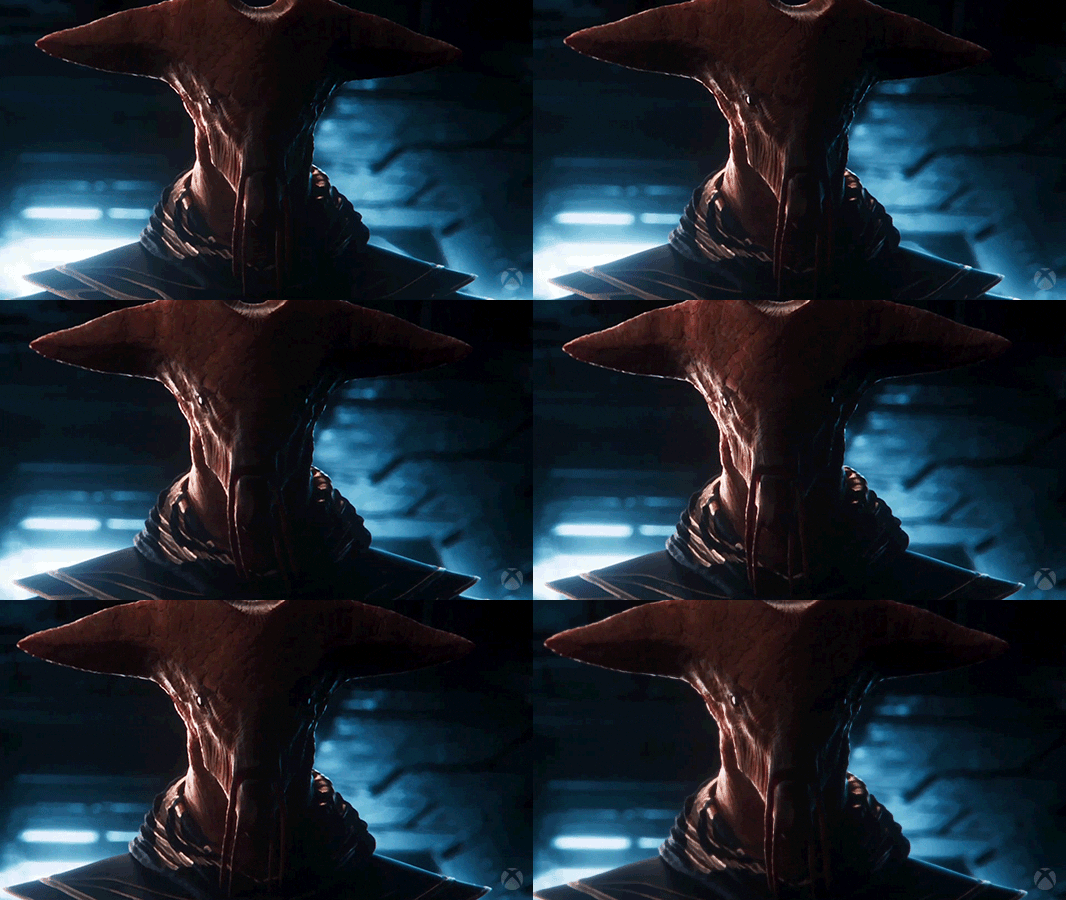
Of course, Stellaris isn’t a Star Trek game, but I had read about a mod for the Trekker universe, which was enough to convince me to download it.
I opened the base game with the arrogance of someone who already knew the Paradox formula perfectly. But, of course, a formula from 2015 undergoes changes. Furthermore, the very concept of Stellaris was different compared to the publisher’s other games. Crusader Kings 2 was about Earth in the Middle Ages, Europa Universalis about mercantilism and the Renaissance, Victoria about… well, the Victorian era, and Hearts of Iron about 20th-century wars. But not Stellaris, Stellaris was about conquering space. The final frontier.
The difficulty and how the game addresses it
I hadn’t even played for five minutes before I was completely lost. Science ships, planets, discoveries, energy, systems… there were so many new concepts. I was totally out of my depth.
The game does offer a sort of tutorial, a robot that guides you step-by-step through the concepts in the worst “mobile game” style possible: “Click here, click there.” If you click anywhere else? Goodbye tutorial, and everything becomes even more confusing.
Eventually, I decided to do the sensible thing: deactivate the tutorial. And that, my friends, is when the game changed. Paradox tutorials are awful, they are scripted in the worst sense of the word and only get in the way. The company’s true tutorial is actually its user interface. Since these games use a clock mechanic, you can freeze time to calmly read, plan strategies, and explore with your mouse. The interface itself is inviting.
The result: there went my Sunday playing Stellaris. I progressed through time, conquered part of the galaxy, met other races, and it all felt extremely organic. I rediscovered that feeling of “I’ll just do one more thing and then I’ll stop.”
The Paradox
I have always defended the thesis that, when developing, code should be self-explanatory, comments are only necessary in specific cases. If you need to explain what was done, something is wrong.
And herein lies the Paradox of Paradox: the game has a tutorial, but the true tutorial is the game itself.