

How Manchester United Proves Barcelona is the Greatest Club in the World (Even While Broke)
I need to say something that might sound counterintuitive. As a Barcelona supporter, I owe a debt of gratitude to Manchester United.
Not because of any friendly rivalry or mutual respect between European giants. No. I am grateful because the catastrophic decline of Manchester United serves as the perfect control group in the grand experiment of modern football. They are the living, breathing proof that money cannot buy greatness.
While Barcelona was drowning in a billion euros of debt, losing the greatest player in history, and selling off pieces of its own future just to keep the lights on, Manchester United was spending. And spending. And spending some more. The result? We are back competing for La Liga titles and scaring teams in the Champions League. They are fighting for fourth place in England and praying Europa League qualification counts as progress.
The crisis saved us. The money damned them.
The Efficiency Abyss
Let’s talk numbers, because numbers don’t lie (unlike transfer rumours).
Over the last decade, Manchester United has accumulated one of the highest net spends in world football. We are talking about figures that surpass even their noisy neighbours at the Etihad. Over a billion euros. The return on that investment? A few domestic cups and one Europa League trophy won by playing defensive football under Mourinho.
Meanwhile, Barcelona, post-Bartomeu apocalypse, managed to win La Liga under Xavi and remain competitive at the top of European football with a squad assembled at a fraction of the cost. Some of our best players cost literally nothing.
Here is the visual example that encapsulates everything:
- Manchester United: Spent approximately €95 million on Antony. A winger who, as of this writing, has contributed less to his team than the average stadium steward.
- Barcelona: Spent €0 on Lamine Yamal. A winger who, at seventeen years old, is already one of the best players on the planet and was instrumental in Spain winning Euro 2024.
The lesson is brutal in its simplicity. Manchester United tries to buy solutions. Barcelona creates them. When the money ran out, we had a savings account called La Masia. They had nothing but chequebooks and delusion.
The Bankruptcy That Saved the Soul
Let me be clear about something. The Bartomeu administration nearly killed this club. The financial mismanagement, the absurd contracts, the panic purchases after Neymar left. Coutinho. Griezmann. Dembélé on wages that would make a Premier League CEO blush. It was a disaster.
And then Messi left. Not because he wanted to, but because we literally could not afford to register him. The greatest player in the history of the sport, a man who had given everything to the shirt, walked away because the institution was broken.
That should have been the end. Any normal club would have collapsed into mid-table obscurity for a generation.
But Barcelona is not a normal club.
What happened instead was a forced return to fundamentals. Laporta, whatever his flaws (and there are many), understood one thing: when you have no money, you must have ideas. And the idea of Barcelona has always been La Masia.
Gavi. Balde. Cubarsí. Fermín. And the crown jewel, Lamine Yamal.
These are not just academy products. They are the philosophical descendants of Xavi, Iniesta, Messi, Busquets. They are proof that the culture survived the financial carnage.
The Institutional Gravity
Here is something that baffles analysts who only look at spreadsheets. Even in the depths of financial chaos, world-class players wanted to come to Barcelona.
Robert Lewandowski, one of the best strikers of his generation, forced his way out of Bayern Munich to join a club that might not be able to pay him on time. Ilkay Gündogan left the Premier League champions to play for a team selling television rights just to afford registrations. Jules Koundé chose Barcelona over Chelsea when Chelsea was offering more money and more stability.
Why? Because the shirt still means something. The institution has gravity.
Now look at Manchester United. Who goes there for the project? Casemiro went there for the wages at the end of his peak years. Varane went there to collect a final paycheque before retirement. The young talents they sign (Sancho, Antony) arrive and immediately regress, as if the environment itself is toxic to development.
Players go to Manchester United for the salary. Players come to Barcelona for the prestige. That is a fundamental difference that no amount of Qatari or American investment can fix.
The European Proof
The 2024/2025 season tells you everything you need to know.
Barcelona won La Liga. We did this while Real Madrid assembled their “Galácticos 3.0” with Mbappé joining Vinícius and Bellingham. We did this with a squad where the average age of our starting midfield could not legally drink in most countries. Hansi Flick came in and built a machine that plays with the intensity of his Bayern teams but the technical identity of peak Barcelona.
In Europe, we reached the Champions League semi-finals. We fell, yes, but we fell fighting. We were favourites in the betting markets for multiple rounds. The shield started to weigh again. Teams feared drawing us.
Manchester United? They are battling for a top-four finish in the Premier League. Their European campaigns have become exercises in embarrassment. No one fears drawing Manchester United anymore. They are a giant that forgot how to walk.
The Culture vs. Commerce Divide
This is the core of my argument. It is not about money. It is about culture.
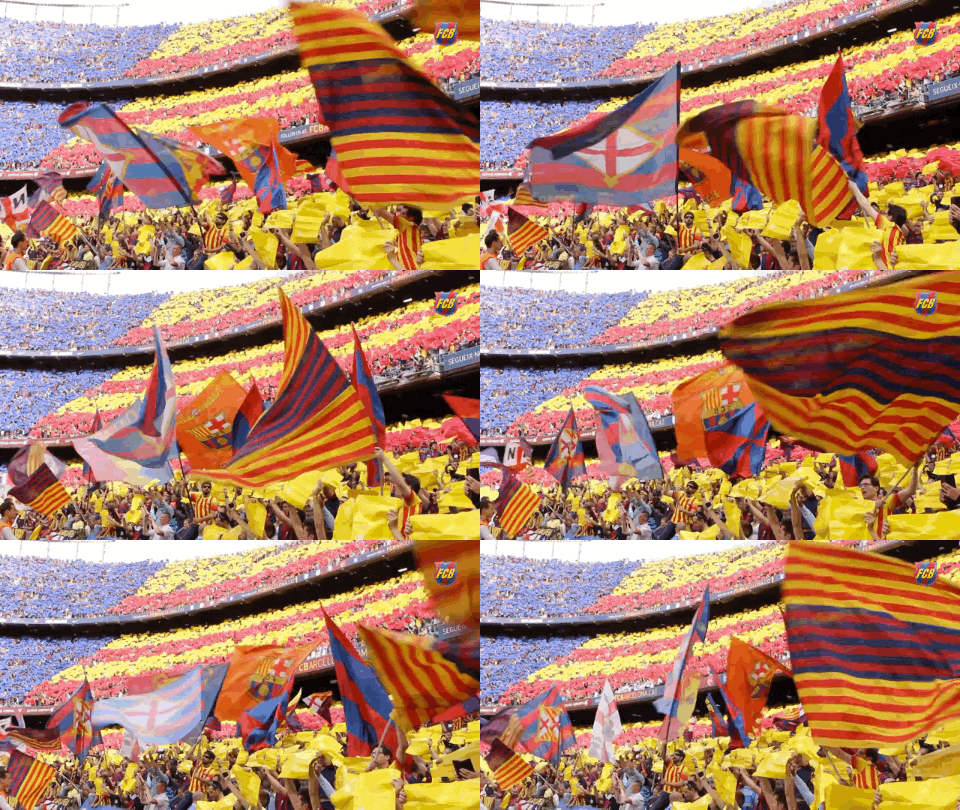
Barcelona is “Més que un club” because the identity exists independently of the bank balance. The style of play, the commitment to youth development, the arrogance (yes, arrogance) to believe that our way is the correct way, these things cannot be purchased.
Manchester United, post-Ferguson, became a commercial entity that happens to have a football team attached. The “United Way” became a marketing slogan rather than a footballing philosophy. The Class of ‘92 spirit was replaced by a revolving door of expensive mercenaries who could not be bothered to press for ninety minutes.
They have the money. They have the global brand. They have the history. But they do not have a coherent idea of what Manchester United football should look like. And without that idea, all the billions in the world are just expensive fuel for a car with no driver.
The Uncomfortable Acknowledgments
I am not blind. I am a Barcelona supporter, but I am not an idiot.
The “alavancas” (the financial levers Laporta pulled) have mortgaged parts of our future. We sold percentages of our television rights and merchandising income to stay afloat. This is not sustainable long-term, and anyone who pretends otherwise is lying.
Manchester United is still a money-making machine. Commercially, they might even surpass us. They can generate revenue. They just cannot generate trophies proportional to that revenue.
And yes, Manchester United has produced good young players recently. Rashford is exciting (in Barcelona). Mainoo looks like a genuine talent. Their academy is not dead. But it is not structural to their identity the way La Masia is to ours. When things go wrong at United, they sign a €100 million player. When things go wrong at Barcelona, we promote a seventeen-year-old and build the team around him.
Greatness
The greatest irony of modern football is that Manchester United’s decline has made Barcelona’s greatness more visible.
We were told that football was now about sovereign wealth funds and unlimited transfer budgets. We were told that romantic notions of “club identity” were relics of a pre-Super League world. We were told that Barcelona, with its debts and departures, was finished.
And yet here we are. Winning leagues. Producing generational talents. Playing football that makes neutrals fall in love with the game again.
Manchester United can buy any player on the planet. But they cannot buy what we have. They cannot purchase a century of youth development philosophy. They cannot acquire the institutional knowledge that turns teenagers into world-beaters. They cannot download a footballing culture into their organisation like a software update.
We were broke. We are still not fully recovered. And we are still Barcelona.
That is what greatness looks like. Not the size of your chequebook, but the depth of your soul.
Thank you, Manchester United. For proving, beyond any reasonable doubt, that we were right all along.
Més que un club. And always will be.