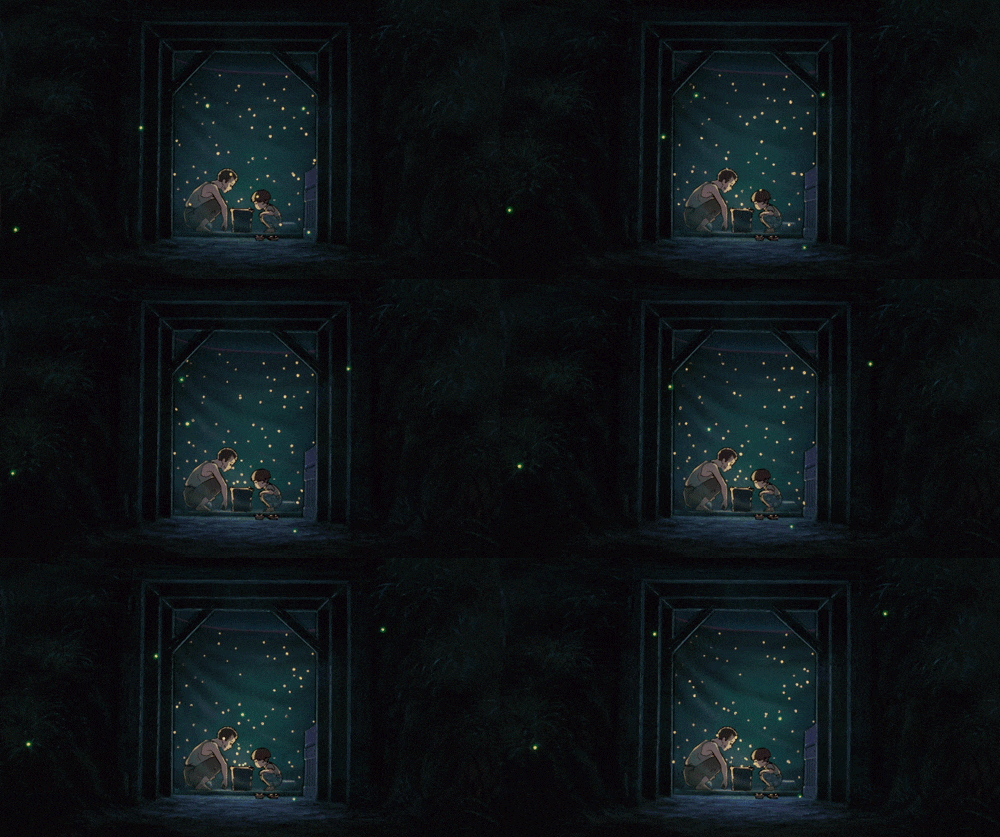



Grave of the Fireflies: The Second Death
I have mentioned before how much I despise the “Disneyfication” of storytelling, where everything needs a happy ending, a catchy song, and a plush toy to sell at the end. If you want the complete opposite of that spectrum, if you want to see a film that doesn’t just punch you in the gut but tears out your heart and leaves it exposed to the elements, you watch Isao Takahata’s Grave of the Fireflies.
People often categorize this film as “that sad war movie.” They are wrong. War is just the background noise, the stage on which the real tragedy plays out. This is a film about the death of childhood.
And I don’t mean the physical death of children. That happens, and it destroys you. But there is a Second Death that occurs before the heart stops beating. It is the systematic dismantling of innocence, the moment when the capacity to imagine, to trust, and to play is eroded by the corrosive acid of reality.
The Collapse of Protection
In a functional society, adults act as a shield. They stand between the chaotic, raw cruelty of the world and the fragile inner life of a child. In Grave of the Fireflies, that shield shatters completely.
Seita, the older brother, tries desperately to emulate this protection. He attempts to keep the “game” alive. He performs gymnastics to convince his little sister, Setsuko, that the world hasn’t ended. He tries to maintain the illusion of childhood.
But the adults? The aunt? She represents the cold, hard logic of survival. There is no space for the “useless” weight of compassion or play in her world. She pushes them out not with violence, but with the passive-aggressive cruelty of someone who has already discarded their own humanity to ensure their own survival.
The Empty Tin
The most terrifying horror story isn’t about ghosts or demons, it’s the scene with the fruit drops tin.
At the beginning, the tin represents magic. It represents sugar, flavor, the last connection to a time when life made sense. As the film progresses, the candy runs out. Seita fills it with water to get the last taste of sweetness.
Then, the tin is filled with marbles. Then, stones. Finally, it contains bones.
This progression is the visual diary of their childhood dying. The capacity to “play”, to imagine that a marble is a candy, is a survival mechanism, but eventually, the hunger becomes a reality that no amount of imagination can fix.
The Name Change: The Final Break
There is a specific milestone in the film that hits harder than the actual ending. It is a subtle shift in language that signals the end of the world.
For most of the film, Setsuko relies on Seita. He is “Ni-chan” (Big Brother). He is the provider, the protector, the surrogate father. This hierarchy is the last vestige of structure in their lives.
But as malnutrition sets in and the reality of their abandonment solidifies, there comes a moment where the hierarchy dissolves. Setsuko stops calling him “Big Brother.” In some translations and moments of delirium, she refers to him simply by his name, or speaks to him as an equal in suffering.
This is the moment of the Second Death.
When she stops seeing him as the omnipotent “Big Brother” and sees him just as Seita, another helpless human being, the illusion breaks. The veil of childhood is stripped away. She is forced to take on the impossible responsibility of dying with dignity, while he takes on the impossible responsibility of failing to save her.
It is a brutally efficient storytelling mechanism. It reminds us that innocence isn’t lost in a single traumatic event, it is starved out, day by day, until the child is forced to look at the world with the dead eyes of an adult, just moments before leaving it.
I usually finish these posts with a joke or a clever analogy. I don’t have one today. This film broke me in 2025 just as hard as it would have in 1988.