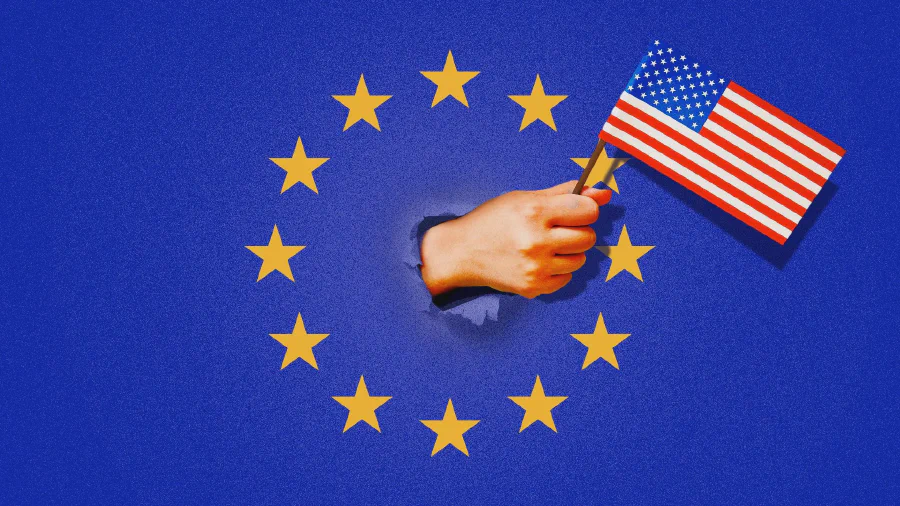



Puppets or Partners? Europe is America’s Biggest Subsidiary
I’m going to start this post differently. No elaborate metaphors, no Star Trek analogies, no code. Just a simple question that has been eating away at my brain since I moved to Europe:
Why the hell do I need an American account to download my own government’s application?
Let me give you some context. I live in Italy. I pay taxes in Italy. I have an Italian fiscal code. And when I need to access the official Italian government app (or Post Office app) to check my tax situation, what do I do? I open the Google Play Store, an American store, with my data stored on American servers, subject to American legislation, to download an application from a European country’s government.
And the most revolting thing is, I have no other choice. It’s either the Play Store or nothing.
Does this not seem absolutely ridiculous to you?
The Farce of European “Digital Sovereignty”
The European Union loves to talk about digital sovereignty. There are conferences, there are directives, there are regulations with pompous acronyms. The GDPR was sold as Europe’s great victory against American technological imperialism. “Now we have control over our data!”, celebrated the bureaucrats in Brussels.
Lies.
The GDPR is a band-aid on a hemorrhaging patient. Yes, now websites have to ask me if I accept cookies. Fantastic. Meanwhile, all of Europe’s digital infrastructure remains dependent on three American companies: Google, Apple, and Microsoft. Our emails pass through their servers. Our documents are in their cloud. Our government applications are distributed through their stores.
Where is the European alternative? Where is the “European Android”? Where is the EU’s app store? It doesn’t exist. Thirty years after the creation of the World Wide Web by a European (Tim Berners-Lee, British, for those who forgot), Europe continues to be a mere consumer of American technology.
The solution is not (only) to monitor the services of American companies, but to have local alternatives backed by European governments.
And don’t come at me with the talk that “the market decided.” The market doesn’t decide anything when there are monopolies. The market doesn’t decide when you have to choose between Google or Apple, and no other viable option. This isn’t free market capitalism, it’s digital colonialism with a different name.
I work in tech. I understand network effects, economies of scale, first-mover advantage. I understand why it’s hard to compete with established platforms. But “hard” and “impossible” are not synonyms. The EU has nearly 450 million citizens, a GDP that rivals the United States, and some of the best universities and engineers in the world. We landed a probe on a comet, for crying out loud. But building an app store? Apparently, that’s beyond our capabilities.
The truth is simpler and uglier: there’s no political will. Building sovereign digital infrastructure doesn’t win elections. It doesn’t generate flashy headlines. It requires long-term investment with no immediate payoff. So instead, we get regulations. We get fines against Big Tech that sound impressive in press releases but amount to pocket change for these companies. We get endless committees discussing “strategic autonomy” while every European citizen remains locked into American ecosystems.
And here’s what really grinds my gears: the hypocrisy of it all. European politicians love to lecture the world about data privacy, about digital rights, about protecting citizens from corporate overreach. They pat themselves on the back for the GDPR while simultaneously making it mandatory for citizens to use American platforms to access basic government services. It’s like bragging about your home security system while handing your house keys to a stranger.
The Uncomfortable Question
At the end of the day, the question that remains is simple: what happens when the “ally” decides we’re not so allied anymore?
When the American administration decides to use access to our data as a bargaining chip? When Google decides that the Italian tax agency’s app violates some obscure policy and removes it from the store? When Apple raises its cut to 50% and every European government app becomes twice as expensive to maintain?
We have no Plan B. We have no alternative. We’ve built our entire digital existence on rented land, and the landlord lives on the other side of the Atlantic.
I’m not naive enough to think Europe can build a competing ecosystem overnight. These things take decades. But we’ve had decades. The iPhone came out in 2007. Android launched in 2008. That’s seventeen years of watching American platforms swallow our digital lives whole, seventeen years of conferences and white papers and “strategic initiatives” that produced exactly nothing.
Europe likes to see itself as a beacon of independence and democratic values. But beacons that run on American electricity don’t illuminate anything, they just blink when Washington allows them to.
Maybe one day we’ll wake up. Maybe one day we’ll have our own digital infrastructure, our own platforms, our own sovereignty that extends beyond strongly worded regulations. Maybe one day European citizens won’t need permission from California to interact with their own governments.
Until then, I’ll keep opening the American Play Store to access Italian services. And I’ll keep feeling that bitter taste in my mouth every single time I do it.