




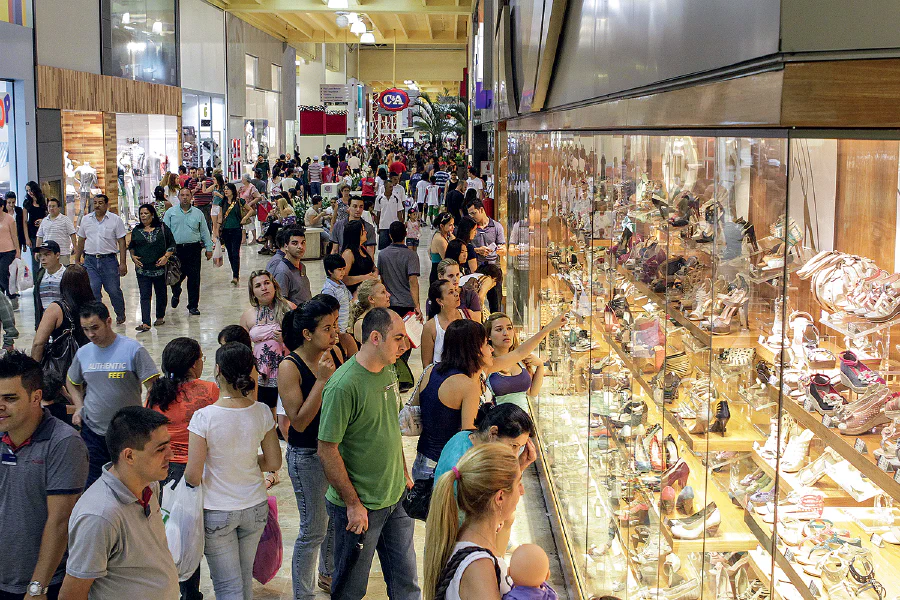
It is a fact that few people would dare to deny that the shopping mall is a key element in large cities today. While it is a place of consumerism, it is also a meeting spot for friends during adolescence, a hub for restaurants and cafes, and a home for cinemas. In recent decades, it has become a space that includes a little bit of everything under one roof.
The progress of capitalism and the rising income of the more privileged classes have changed the consumption habits of the population. One region that has stood out in this regard is Latin America, with Brazil as a primary example. Since the 1960s, when the first mall opened, the country has grown to include more than 640 of these establishments, with new openings occurring every year. There are extreme cases like the state of São Paulo, which currently boasts the impressive figure of 197 shopping centers, which is a staggering number.
While the sector is consolidated in European countries like Spain or Italy, and is in a period of sharp decline in the United States, the country that invented the model, dropping from over 2,500 malls to barely 1,000 today, Brazil continues to see new establishments open every year with record-breaking revenue figures.
The Brazilian situation diverges from other countries not only in terms of numbers but also in the types of businesses these places house. In Europe, it is normal for clothing stores and restaurants to occupy almost all available space. In Brazil, however, it is common to find gyms, travel agencies, mini amusement parks for children, health clinics, coworking spaces, pharmacies, public offices, and many other services.
Neither the accelerated digitalization of society nor the massive figures of online shopping have caused Brazilians to abandon the shopping mall. Instead, they are mirroring an American model of leisure and consumption that Americans themselves abandoned years ago.
These business choices are not a coincidence. While people in Europe mainly seek convenience and a high density of options when buying a pair of pants or boots, shopping malls in Brazil offer something more. Beyond the shopping experience, they provide the sense of security that is so often missing on the streets.
Business opening hours also push people toward the interior of these large buildings. Many street-level businesses close at 5:30 PM or 6:00 PM and do not even open on weekends. When you need to buy something after work, it does not matter if it is winter or summer, or if it is raining or sunny, the only answer is always to go to the mall.
Beyond the destruction of small businesses and the resulting unemployment and fraying of the local commercial fabric, this euphoria for mall consumption reflects the loss of safe spaces where people can interact without an economic transaction being essential. In recent years, places like parks, plazas, and libraries have been lost at an accelerated pace. These areas are being replaced by what the French philosopher Marc Augé called non-places, which are locations focused on consumption where you may be surrounded by people but do not interact with them, such as hotels, airports, supermarkets, and, of course, shopping malls.
Safety in these places is guaranteed, but human connection is not. This loss is felt by everyone from adults to the very young. In countries like Spain, it is still common even in large cities for children to run and play with others in public squares. In Brazil, these places almost do not exist or are not used. They are increasingly replaced by paid playgrounds inside the mall, which often require an exorbitant fee.
Parks do exist, and since this is Brazil, there are large green areas. However, they are used more for sports or walking pets, and users often carry the fear of being robbed of their phone or wallet. Additionally, access is complicated due to sidewalks being in poor condition or entirely absent. This, combined with expensive and inefficient public transport, often forces people to travel by car, which makes a casual stroll impossible for children or teenagers. European scenes of streets full of pedestrians, even at night, are unthinkable in Brazil, where most streets empty out as soon as the sun sets.
This might seem harmless or simply a matter of personal choice. However, when there is no viable alternative, going to the shopping mall is not a choice but an imposition caused by state negligence. It is a place where you have to spend money from the moment you park your car and where you can be surrounded by people without speaking a word to anyone. It exchanges fresh air and enriching experiences for an afternoon of air conditioning. In short, it is a societal grinder and an ode to consumption for the sake of consumption.